Outdoor Living in La Nucia
La Nucia is a modern inland town of 20,000 residents where 52% are expats — British, Dutch, and Scandinavian — attracted by affordable hillside properties, world-class sports facilities, and a thriving Sunday rastro market.
La Nucia has reinvented itself over the past two decades. Once a sleepy agricultural village behind Benidorm, it is now one of the most forward-thinking municipalities on the Costa Blanca, with a nationally recognised sports complex and infrastructure that rivals towns three times its size. The Sunday rastro market draws thousands weekly as one of the largest fresh-produce markets in the Alicante province.
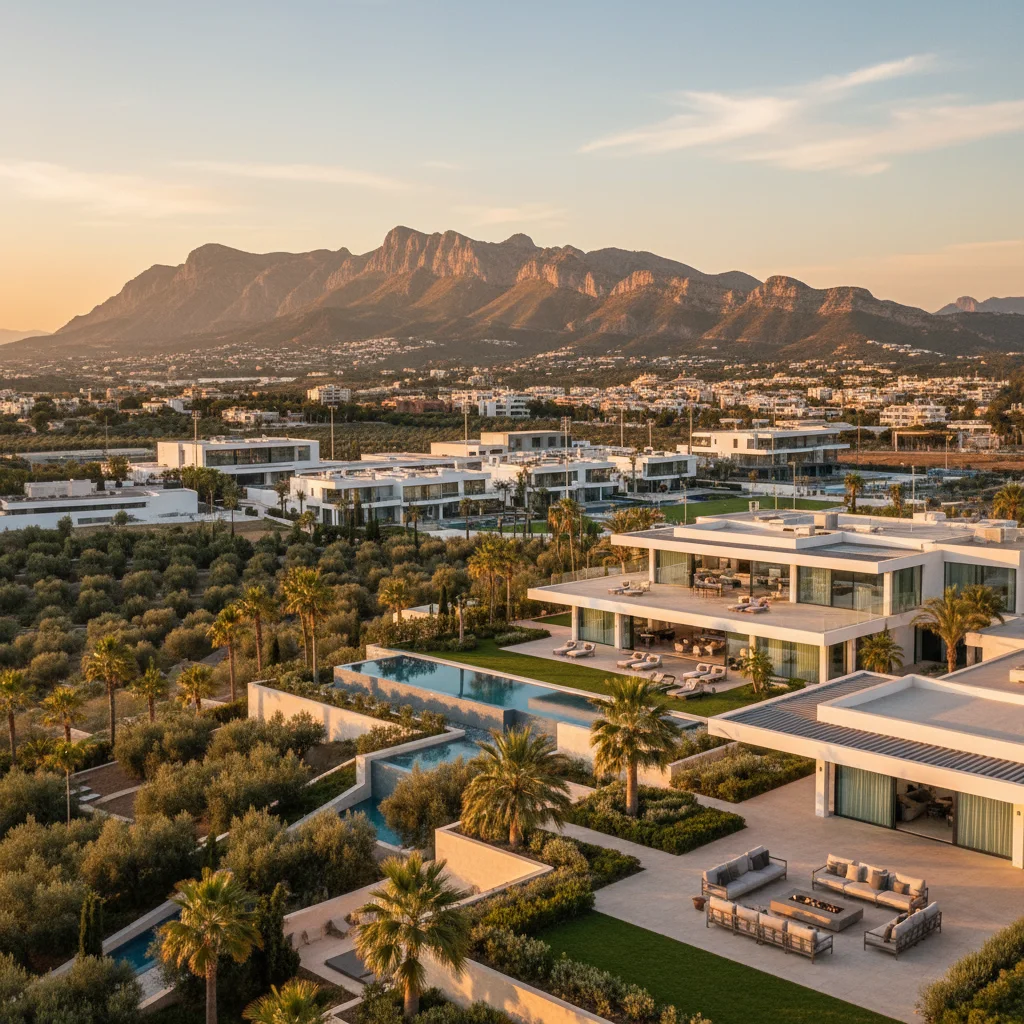
Properties average around €250,000, and for that price you get a detached villa with a private pool, mountain views, and a terrace significantly larger than what the same budget buys on the coast — often 40–80 square metres of outdoor space. At roughly 200 metres elevation, summer evenings are cooler than the seafront and winter days are crisp and sunny — perfect for a long kamado cook.
The community is active and outdoorsy. Hiking, cycling, and using the town’s Olympic-grade sports facilities are all part of daily life. That culture feeds directly into outdoor cooking — residents here treat grilling as fuel for an active lifestyle, not just a weekend novelty.
La Nucia offers hillside villas with 40–80m² outdoor spaces averaging €250,000, cooler summer evenings than the coast, and an active expat community of 10,000+ who cook outdoors year-round.
Choosing Your Setup in La Nucia
La Nucia’s spacious hillside terraces and mild inland climate make it ideal for versatile setups combining gas BBQs for convenience with kamado grills or pizza ovens for weekend cooking projects.
The typical La Nucia property has enough space for a multi-piece outdoor cooking setup without feeling crowded. A common configuration we install here is a gas BBQ for weeknight speed paired with a kamado grill for weekend slow-cooking — positioned apart on the terrace so both can run simultaneously when entertaining.
Costa Blanca Outdoors recommends considering the slightly cooler inland evenings when choosing equipment. A kamado grill retains heat brilliantly and performs just as well at 12°C in January as it does at 35°C in July — making it arguably the best single-piece investment for La Nucia’s year-round cooking season. The ceramic insulation also means fuel efficiency, using roughly half the charcoal of an open grill for the same cooking time.
Wood-fired pizza ovens are a natural fit. La Nucia’s inland position means firewood is more accessible and affordable than on the coast. Orange groves and almond orchards surround the town, and suppliers sell seasoned wood by the sack or trailer load. The Sunday rastro itself is a reliable source for firewood and charcoal.
Costa Blanca Outdoors recommends kamado grills as the best single-piece investment for La Nucia, with ceramic insulation performing equally well in January at 12°C and July at 35°C while using half the charcoal of open grills.
Delivery to La Nucia
We deliver to La Nucia on our central inland route weekly, with experience navigating the town’s hillside residential streets and gated urbanisations.
La Nucia sits just inland from our Benidorm–Alfaz del Pi coastal route, making it a natural addition to our central delivery schedule. Most residential areas have wide roads, though some older hillside urbanisations require smaller vehicles for heavy items.
Every delivery includes full setup: unpacking, assembly, placement on your terrace or in your garden, and a walkthrough of your new equipment. For built-in outdoor kitchen projects, we work with local builders who understand La Nucia’s municipal building guidelines and community regulations.
Alfaz del Pi and Benidorm are on the same delivery corridor, and we also reach Altea and the northern coast from here. Expect 5–10 working days for in-stock items, or 3–4 weeks for custom kitchen installations including design, fabrication, and professional fitting.
The Professional Approach to Outdoor Kitchens in La Nucía
Living on this stretch of the Costa Blanca since 2019 has taught me that outdoor cooking is far more than a Sunday hobby; it is a fundamental shift in how we inhabit our homes. This particular town occupies a unique geographical sweet spot, nestled between the dramatic mountain backdrop and the Mediterranean. With a population of 20,000 residents, over half of whom are expats from Britain, the Netherlands, and Norway, the local culture has evolved into a sophisticated blend of northern European efficiency and Spanish leisure. This international demographic brings a high standard for home improvement, particularly when it involves extending the living area onto the terrace or into the garden. Whether you are situated near the Ciutat Esportiva or have a property overlooking the valley toward the sea, the transition from an indoor kitchen to an outdoor culinary station is the single most effective way to add value to your property, which currently averages around 230,000 EUR but can vary wildly depending on the elevation and view.
The property stock here is incredibly diverse, ranging from compact apartments in the town centre to sprawling villas in established urbanisations like Panorama or El Tossal. This diversity means a one-size-fits-all approach to outdoor kitchens simply fails. For the British residents, the focus is often on a social hub centered around a high-performance gas grill. Our Dutch and Norwegian neighbors frequently prioritize minimalist design and technical durability, often incorporating advanced elements like induction hobs or specialized kamado-style cookers. When you spend your mornings at the local Sunday Market sourcing fresh artichokes, local honey, and high-quality meats, you quickly realize that a basic portable charcoal tray does not do justice to the produce available in this region. You need a setup that allows for temperature control, prep space, and easy cleanup, effectively mirroring the functionality of your indoor kitchen but without the heat buildup inside the house during the intense July and August months.
Designing these spaces requires an understanding of the local microclimate. You are positioned in a landscape that is beautiful but demanding on materials. The lifestyle here revolves around the exterior of the home for at least ten months of the year, yet many homeowners still struggle with under-equipped setups that force them to run back and forth to the indoor fridge or sink. A true outdoor kitchen solves this by integrating refrigeration, running water, and specialized cooking zones. This isn't about luxury for the sake of it; it is about practical utility in a climate where indoor cooking can raise the temperature of your home by several degrees, forcing your air conditioning to work harder and increasing your energy bills. By moving the heat source outside, you create a more comfortable indoor environment while embracing the open-air lifestyle that brought most of us to the Costa Blanca in the first place.
Technical Considerations for the Local Climate and Environment
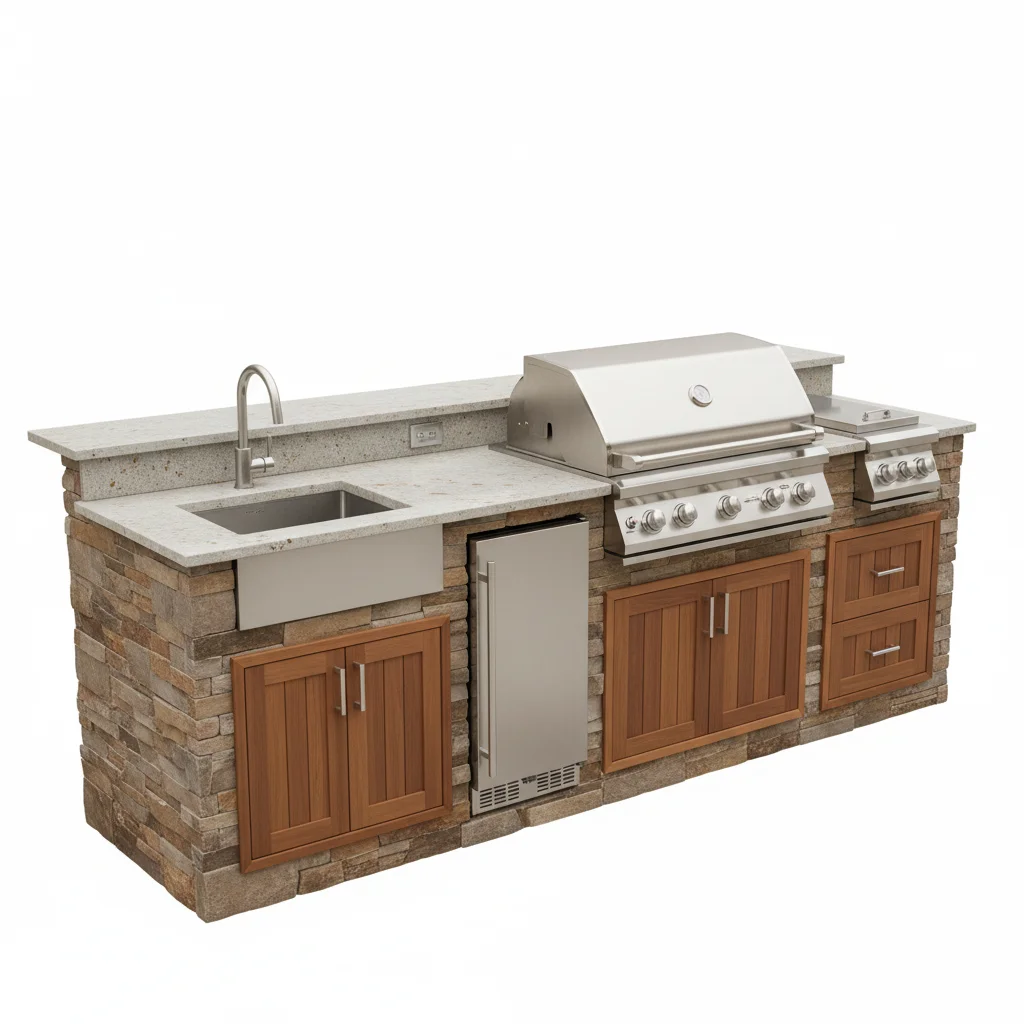
The environmental conditions in this part of Spain are notoriously harsh on construction materials and kitchen appliances. While you are slightly elevated and tucked away from the immediate beachfront of Altea or Benidorm, you are still well within the 2km zone where salt spray can be carried by the wind, leading to accelerated corrosion. The Levante wind brings humidity and salt from the sea, while the Poniente wind from the interior brings dry heat and fine dust. This atmospheric combination creates a grinding paste that can ruin low-grade 304 stainless steel within a couple of seasons. For any outdoor kitchen installation in this area, I strictly recommend using 316 marine-grade stainless steel or powder-coated galvanised steel. If you opt for a modular setup, ensure the hinges and drawer runners are specifically rated for outdoor use. A mid-range modular kitchen with a high-quality sink and weather-resistant cabinetry typically starts around 8,500 EUR, and it is a necessary investment to avoid the heartbreak of seeing rust spots appear after the first winter rains.
The sun is your biggest enemy here. The UV index on the Costa Blanca remains high for most of the year, which causes standard plastics to become brittle and fades low-quality stone or composite worktops. When selecting a work surface, natural granite is a solid choice, but it must be sealed annually to prevent staining from oils or red wine. Alternatively, I highly recommend ultra-compact surfaces like Dekton. These materials are fired at such high temperatures that they are essentially immune to UV damage, thermal shock from hot pans, and scratches. In a town where the mountain backdrop often creates a "venturi effect," accelerating winds through garden corridors, your kitchen structure must be heavy and properly anchored. I have seen lightweight, freestanding units tipped over or shifted during a strong autumnal "Gota Fría." If you are building on a terrace, you must also consider the weight loading. A fully equipped stone-clad kitchen can weigh upwards of 500kg per linear metre, which may exceed the structural capacity of certain balcony types common in the older apartments near the town centre.
Practical installation also involves navigating the local regulations and community rules, known as the Comunidad de Propitarios. If you live in an urbanisation, you must check the statutes before installing any permanent structure or chimney. Gas safety is another critical factor. Most residents here rely on Butano or Propano bottles. Your outdoor kitchen design must include a ventilated cabinet specifically for these bottles, ensuring they are kept out of direct sunlight and are easily accessible for the Cepsa or Repsol delivery trucks. For those looking at a high-end setup, such as a built-in Bull Gas Grill which might cost around 4,500 EUR just for the unit, the gas connection must be executed with copper piping and a certified regulator to meet Spanish safety standards and insurance requirements. Maintenance is also different here than in northern Europe; the "Calima" dust from the Sahara can coat your surfaces overnight, so I always advise clients to include integrated covers or to design their kitchen with a slight slope on the worktops to prevent muddy water from pooling after a light rain.
Recommended Configurations for Local Property Types
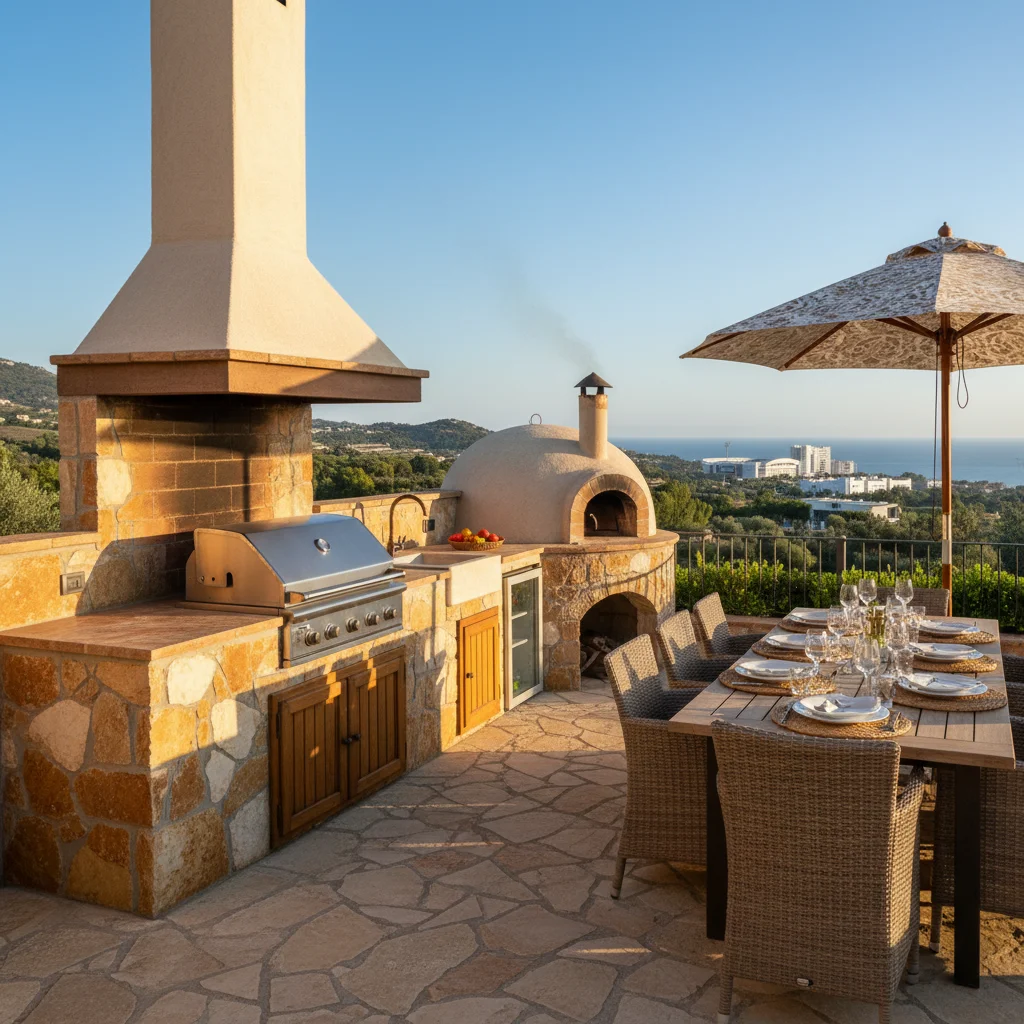
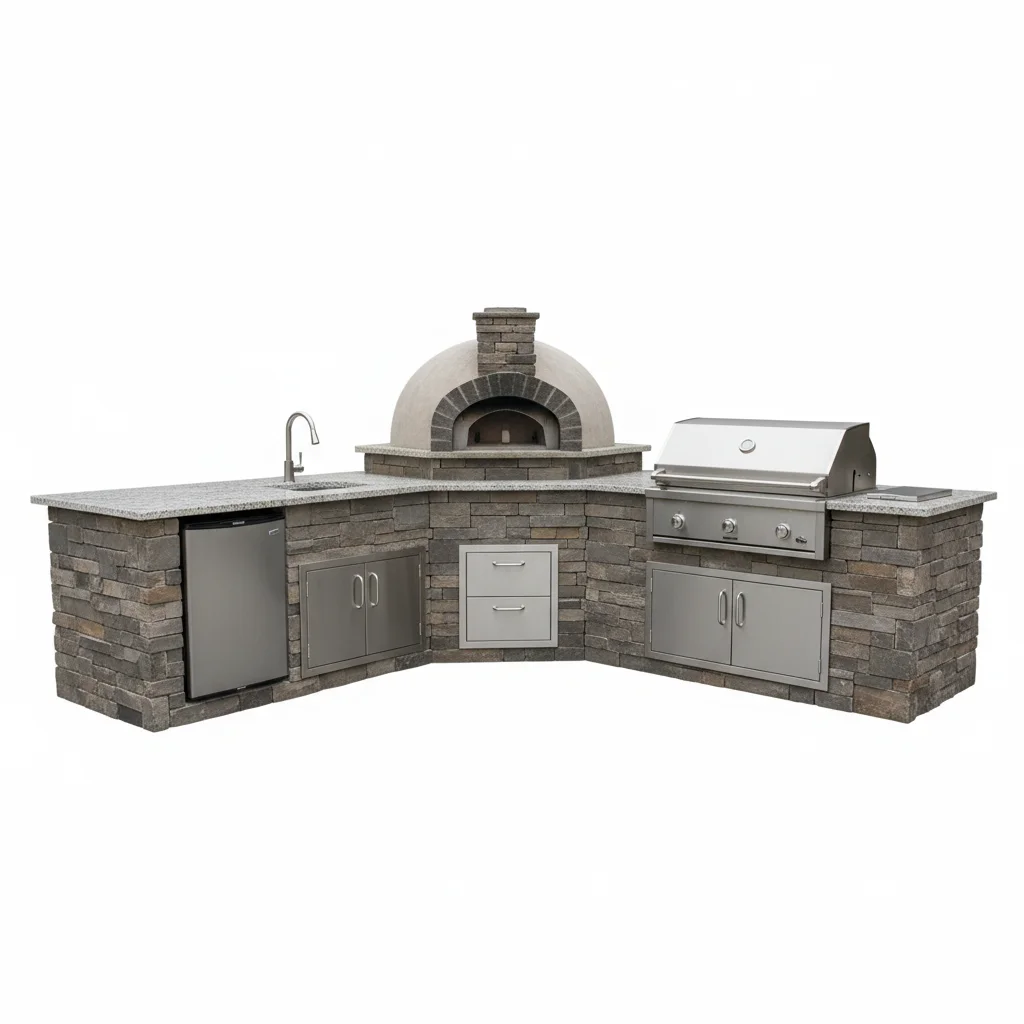
For the villa owners in the surrounding hills, space is rarely the primary constraint, but wind protection is. I recommend an L-shaped or U-shaped configuration that creates a protected "cockpit" for the chef. In this setting, the combination of a high-output gas BBQ and a ceramic kamado is the gold standard. The gas grill provides the convenience for mid-week meals, while the kamado, such as a Big Green Egg or Monolith, allows for low-and-slow smoking or high-heat pizza baking during weekend gatherings. A comprehensive setup for a villa, including a double-door outdoor fridge, a sink with a pull-out spray tap, and integrated waste bins, usually falls in the 15,000 EUR to 22,000 EUR range. This investment transforms a simple garden into a professional-grade culinary space that rivals the best restaurants in nearby Altea. It is vital to position the cooking zone so the prevailing Levante wind carries smoke away from the main seating area and, more importantly, away from your neighbor's terrace.
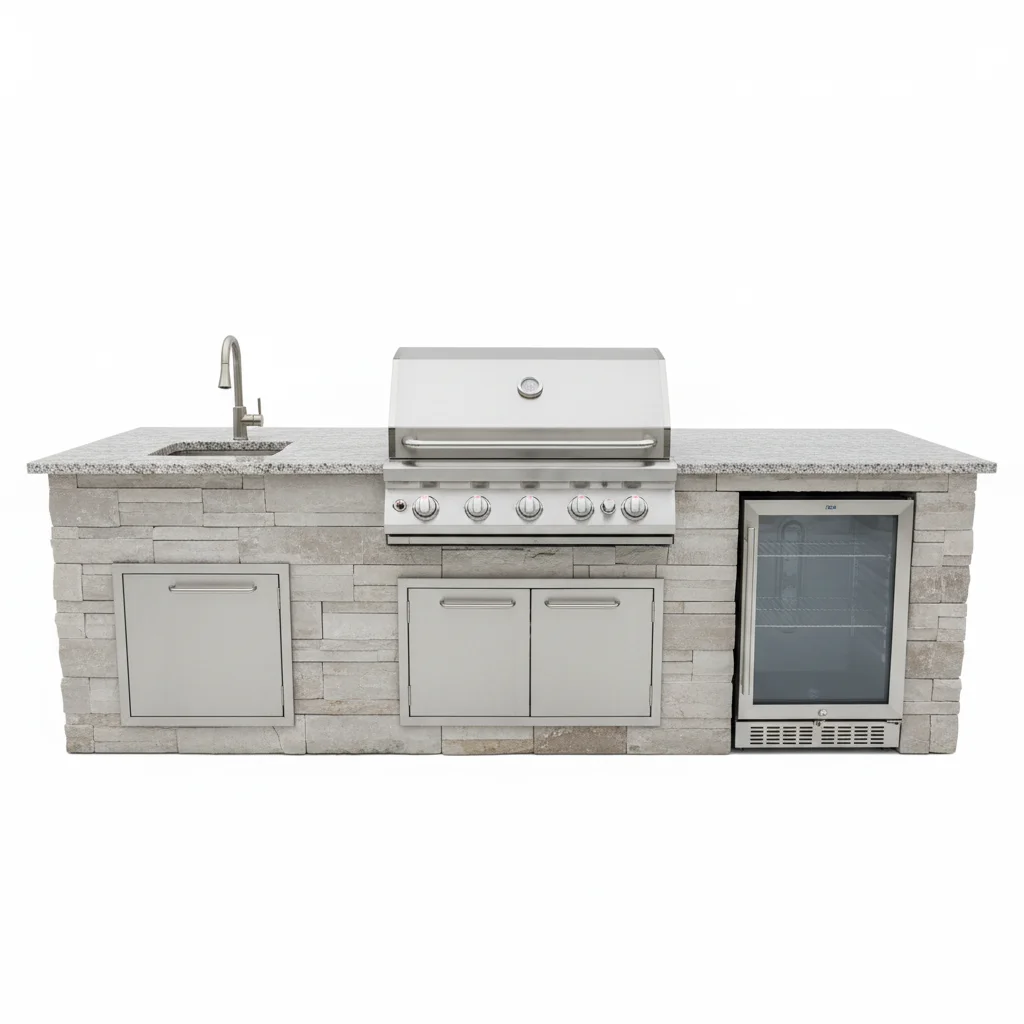
If you are living in one of the modern apartment complexes or townhouses with more restrictive outdoor space, a modular linear approach is far more effective. You don't need five metres of cabinetry to have a functional outdoor kitchen. A 1.5-metre modular unit can house a premium integrated gas grill and a small prep area. For these smaller spaces, I often suggest a high-quality electric grill or a compact gas model to minimize smoke and comply with tighter community regulations. A very effective setup for a compact terrace involves a mobile trolley system with a high-grade stainless steel top, which can be moved into a sheltered corner when not in use. You can expect to pay between 3,500 EUR and 6,000 EUR for a durable, compact setup that includes a premium grill and weather-resistant storage. The key here is vertical organization—using wall-mounted rails for tools to keep the limited counter space clear for food preparation.
Regardless of your property type, I always advocate for the inclusion of a dedicated pizza oven if space permits. These are not just for pizza; the dry heat of a wood-fired or gas-powered oven is perfect for roasting local lamb or finishing steaks. On the Costa Blanca, the outdoor kitchen becomes the heart of the home, especially during the festive periods when the weather is mild enough to eat lunch outside on Christmas Day. By integrating different cooking methods—gas for speed, charcoal for flavor, and stone-baked for texture—you create a versatile space that caters to all tastes. This is particularly important for the 52% of us who moved here from elsewhere; our outdoor space is where we host visiting family and friends, and having a well-thought-out kitchen makes those occasions seamless rather than stressful.
Delivery Logistics and Local Expertise
Navigating the logistics of delivery and installation in this region requires more than just a GPS. The geography of the area, from the winding streets of the old town to the steep inclines of the mountain-side urbanisations, presents specific challenges. We have spent years perfecting the delivery process to this town and the neighboring areas of Alfaz-del-Pi, Benidorm, Altea, and Finestrat. We understand that a delivery to a penthouse in Benidorm requires a different set of tools and permissions than a delivery to a finca in the valley. We are familiar with the local access roads and the specific times of day when traffic near the Sunday Market or the Ciutat Esportiva can make logistics difficult. Our team doesn't just drop a crate at your gate; we understand the terrain and the structural requirements of the properties here.
When we manage an installation, we take into account the specific orientation of your property. We know how the sun moves across the valley and which areas will be most affected by the afternoon heat. This local knowledge allows us to advise on the best placement for your fridge—ensuring it isn't in direct sunlight where the compressor would have to run 24/7—and the most sheltered spot for your grill to prevent the wind from blowing out the burners. We also coordinate with local plumbers and electricians who are familiar with the specific utility standards of the Valencian Community. Whether you are in a new build with modern infrastructure or an older property that requires a more creative approach to piping and wiring, we have the local network to ensure the job is done correctly the first time.
Our commitment to the residents of this town is built on transparency and genuine expertise. We have helped over 200 families across the Costa Blanca create their ideal outdoor environments, and we know that every project is a significant investment in your quality of life. We provide a level of insight that only comes from living and working in this specific environment for years. We invite you to reach out for a consultation where we can discuss your specific terrace or garden dimensions, your cooking style, and your budget. We will walk you through the material choices that make sense for your specific location, whether you are dealing with more salt air or more mountain wind. Our goal is to ensure that your outdoor kitchen is not just a feature of your home, but a durable, functional, and frequently used part of your daily life in Spain.
 JW'"
/>
JW'"
/>