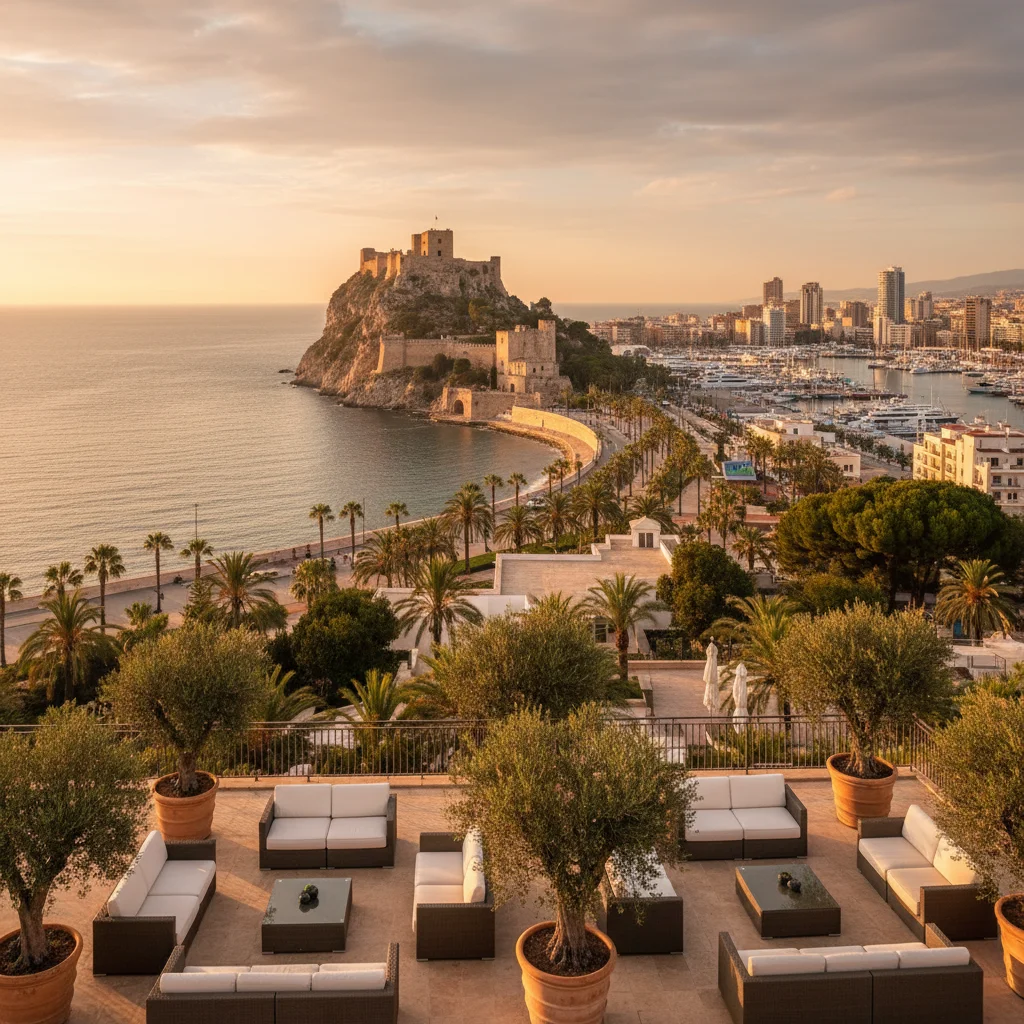
Alicante is where urban energy meets coastal lifestyle. The city rises from the sweeping Explanada promenade up through the narrow streets of the Barrio de Santa Cruz to Santa Bárbara Castle perched on Mount Benacantil. It is a proper Mediterranean city — not a resort — with international schools, a major airport, excellent healthcare, and a cultural calendar that keeps terraces busy twelve months a year.
The expat community is cosmopolitan: British, French, Italian, and increasingly Nordic and Eastern European residents mix with a large Spanish population. Property prices average around €250,000, ranging from compact city centre apartments near the Mercado Central to spacious penthouses with wraparound terraces in the Cabo de las Huertas headland. The San Juan corridor running north toward San Juan de Alicante offers suburban villas with private gardens, while areas like Vistahermosa and Albufereta provide hillside homes with panoramic sea views.
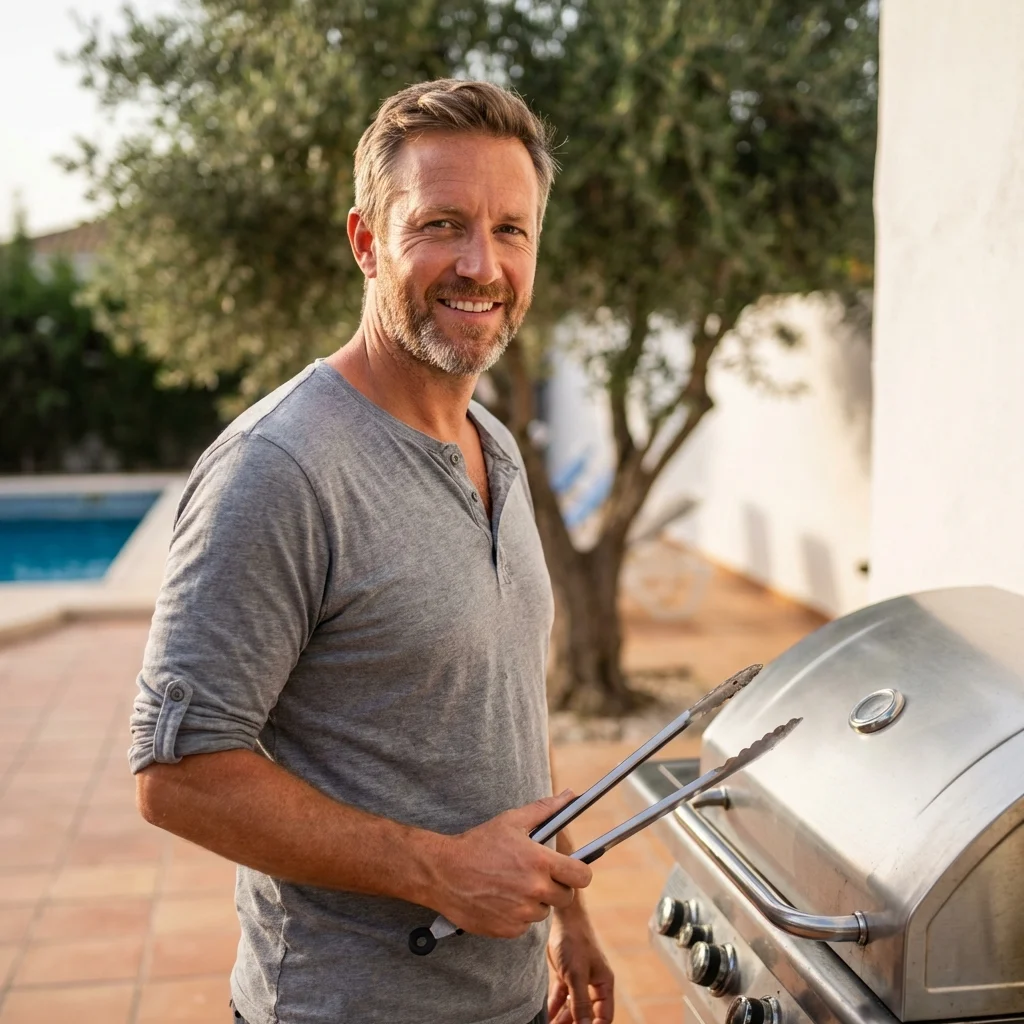
Outdoor cooking is not seasonal here — it is a way of life. Alicante’s mild winters (average January highs of 17°C) mean that a well-equipped terrace functions as an extension of the kitchen year-round. From tapas evenings on a penthouse rooftop overlooking the harbour to Sunday paellas in a San Juan garden, the demand for quality outdoor cooking equipment is constant.
City centre apartments in the Barrio de Santa Cruz and around the Plaza de los Luceros typically have smaller terraces of 8–12 square metres. A two-burner gas BBQ or a compact kamado (38cm) fits these spaces perfectly while delivering serious cooking performance. Penthouse terraces in newer developments along the Playa de San Juan or in Cabo de las Huertas offer 15–30 square metres — enough for a three- or four-burner gas station with side burner, ideal for entertaining.
Suburban villa owners in the San Juan corridor and Vistahermosa have space for the full treatment. Costa Blanca Outdoors designs built-in outdoor kitchens with gas grills, preparation counters, pizza ovens, and storage — turning a poolside terrace into a complete cooking and entertaining area. These setups are particularly popular with British and French residents who host regularly.
Salt air is a real factor in Alicante. Any property within a kilometre of the coast — and that includes most of the city — benefits from marine-grade stainless steel construction. Costa Blanca Outdoors stocks 304 and 316 stainless-steel models specifically for coastal installations, ensuring your investment lasts well beyond the standard three-season lifespan of cheaper alternatives.
As the provincial capital, Alicante is the hub of our delivery network. The city centre has some traffic restrictions and limited-access streets, particularly in the Old Quarter around the Mercado Central and Santa Cruz — we schedule these deliveries during permitted hours and coordinate building access in advance. Beachfront and Cabo de las Huertas deliveries are straightforward with good parking and lift access in most modern buildings.
For apartment deliveries, our team handles everything from ground-floor unloading to terrace placement, including unpacking, assembly, and a full equipment walkthrough. Villa deliveries in the suburban areas around Vistahermosa and the San Juan corridor are typically the simplest, with direct driveway access.
Premium Bioclimatic Pergolas in Alicante: Engineered for L'Alacantí's Coastline
Alicante, the vibrant heart of the L'Alacantí comarca, represents the pinnacle of Mediterranean outdoor living. With a growing population of 358,608 residents as of 2024, the provincial capital has evolved into a dynamic, cosmopolitan hub. This growth is driven in part by a diverse international community, with approximately 27% of the population being foreign-born. From the sun-drenched penthouses of Playa de San Juan to the sprawling suburban villas of Vistahermosa, the demand for high-end, functional outdoor spaces has never been greater.
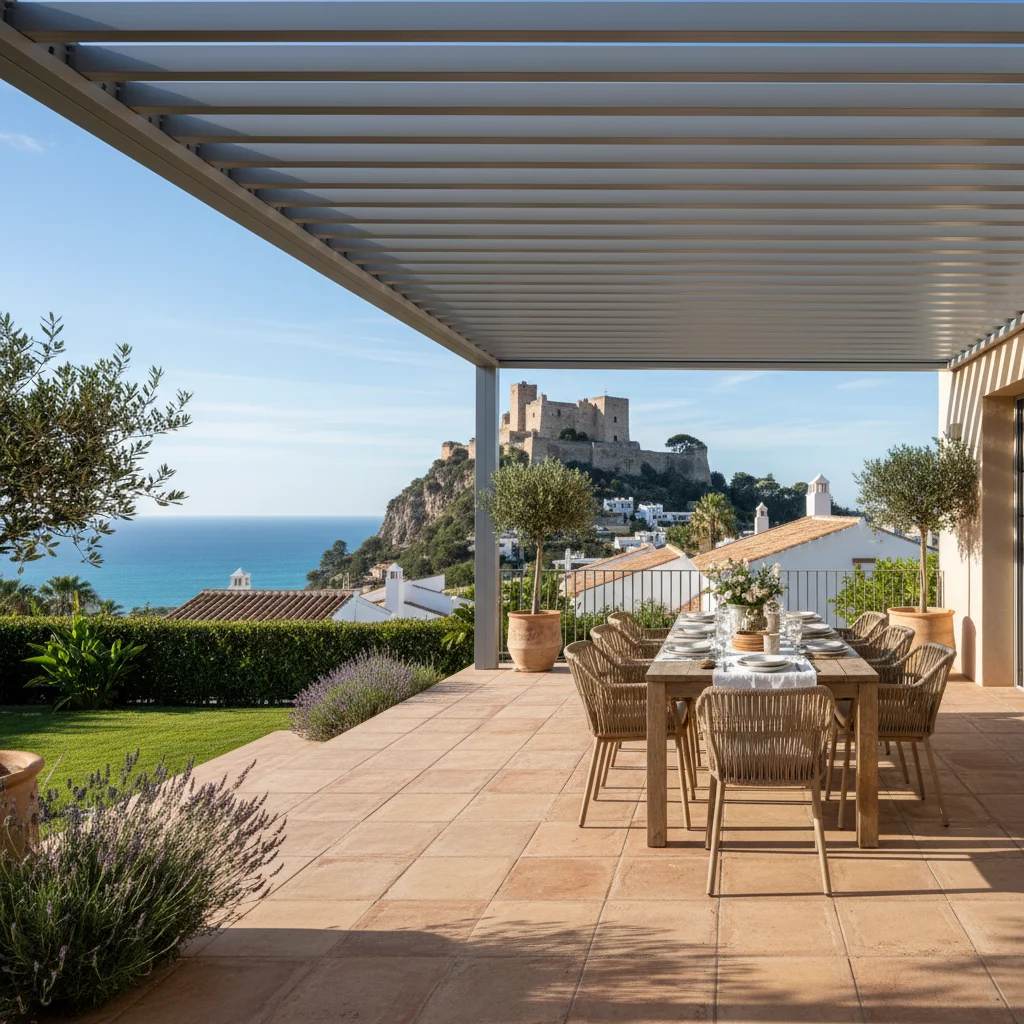
As expert installers of pergolas bioclimáticas (motorised aluminium pergolas with orientable louvres) across the Costa Blanca, we understand that an outdoor installation in Alicante is not just about aesthetics. It is about engineering a structure that can withstand a highly specific, demanding coastal microclimate while seamlessly expanding your usable living space. A bioclimatic pergola provides the ultimate control over light, ventilation, and temperature, transforming exposed terraces into year-round sanctuaries.
The Alicante Microclimate: Why Bioclimatic Engineering is Essential
To design a pergola that lasts for decades in Alicante, one must design for the local elements. The city enjoys roughly 3000 hours of sunshine per year, with summer high temperatures averaging a hot 31 degrees Celsius. However, the raw temperature only tells half the story.
High UV and Solar Reflection
During the long summer months, the UV index in Alicante routinely reaches extreme levels of 9 to 10. This intense solar radiation is further amplified by environmental reflection. Properties along the coast experience a double-exposure effect due to the sun reflecting off the Mediterranean Sea. Even in the urban centre, the polished, iconic marble tiles of the Explanada de España and surrounding plazas reflect significant glare and heat back up into nearby apartments and penthouses.
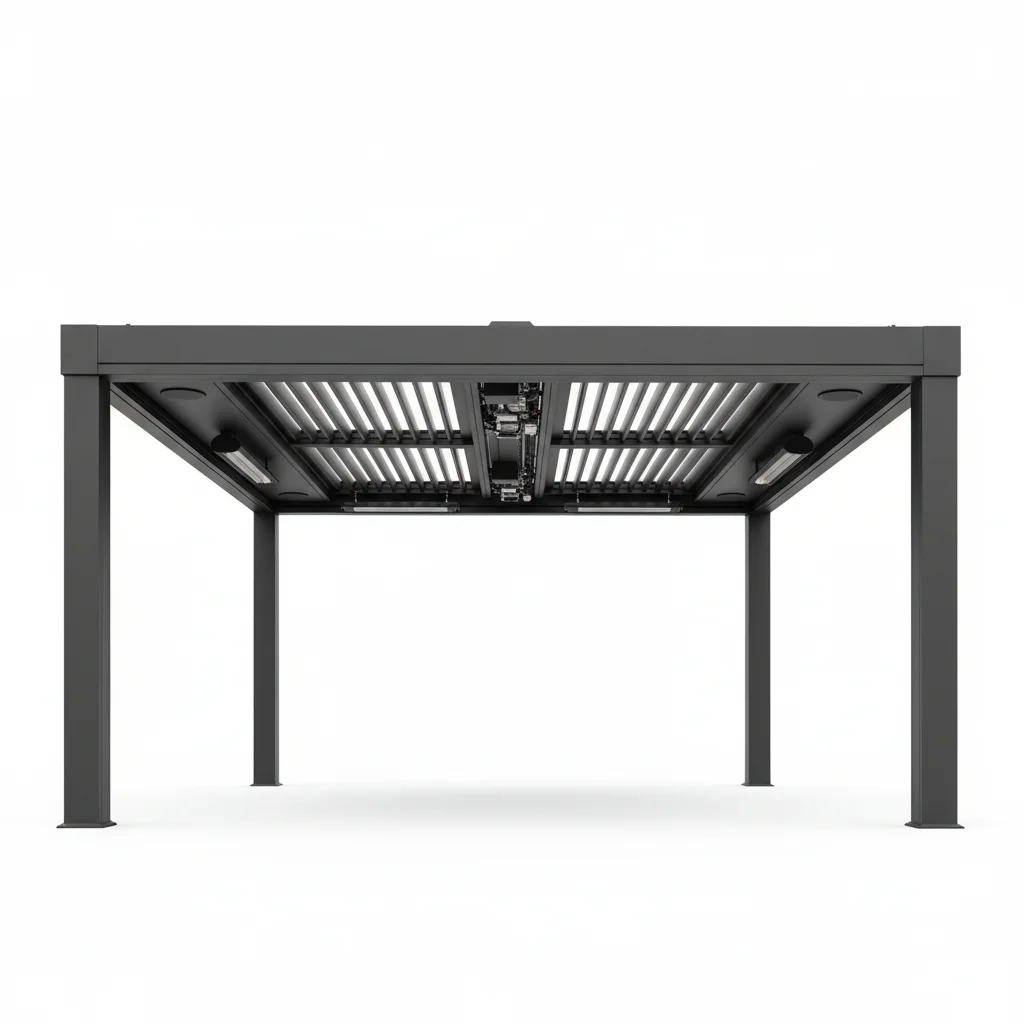
Standard canvas awnings or lightweight wooden structures quickly degrade, fade, and warp under these conditions. Our motorised aluminium bioclimatic pergolas feature double-walled, orientable louvres that can be adjusted from 0 to 135 degrees. This allows you to block direct overhead UV rays completely while keeping the louvres slightly cracked to encourage natural convection, drawing hot air upward and out of the seating area.
The Battle of the Winds: Levante vs. Poniente
Alicante's geography, dominated by the towering Mount Benacantil and the Castillo de Santa Bárbara, influences local wind patterns. The dominant wind is the Levante (East), a humid sea breeze that carries moisture and salt spray directly onto coastal properties. In contrast, the city occasionally experiences the Poniente (West) wind, which blows from the dry interior, bringing hot, dusty air in summer.
To handle these opposing forces, our pergolas are engineered and certified to meet the stringent Clase 6 UNE-EN 13659 standard, guaranteeing structural integrity and wind resistance up to 175 km/h. This wind rating is critical for frontline coastal installations and high-rise penthouses where wind shear is significantly magnified.
Salitre (Sea-Salt) Corrosion
Being a coastal city, Alicante has extremely high salitre (sea-salt) exposure. Salt-laden air is highly corrosive to standard metals and low-grade finishes. To combat this, we supply and install pergolas made exclusively from high-grade extruded aluminium treated with Qualicoat Seaside powder coating. This specialized pre-treatment process strips impurities from the metal before coating, preventing filiform corrosion and ensuring the finish will not bubble, peel, or fade, even when installed on beachfront properties overlooking the marine reserve of Tabarca Island.
Torrential Rain and the Gota Fría
While Alicante is generally arid, with an average annual rainfall of only 285 mm, this precipitation does not fall evenly throughout the year. The autumn months regularly bring the phenomenon known as the gota fría (cold drop)—brief but extraordinarily violent downpours that can drop a month's worth of rain in a single hour.
A standard outdoor cover will quickly pool water and collapse under this weight. Our bioclimatic pergolas feature a fully integrated, invisible guttering system built directly into the support columns. The louvres are designed with compression seals that channel water into these perimeter gutters, boasting a drainage capacity of 60 litres per square metre. This ensures that even during a sudden autumn deluge, your terrace remains dry and your outdoor furniture is fully protected.
Tailoring Installations to Alicante's Diverse Neighborhoods
Alicante is a city of distinct architectural styles and landscapes. Our installations are customized to match the structural and aesthetic demands of each specific zone.
+------------------------------------------------------------------------------------------------+
|                                ALICANTE NEIGHBORHOOD REQUIREMENTS                              |
+----------------------------------+----------------------------------+--------------------------+
| Zone                             | Primary Environmental Challenge  | Key Structural Solution  |
+----------------------------------+----------------------------------+--------------------------+
| Playa de San Juan & Albufereta   | High winds & extreme salitre     | Clase 6 wind resistance,  |
|                                  | (sea-salt) exposure              | Qualicoat Seaside finish |
+----------------------------------+----------------------------------+--------------------------+
| Vistahermosa & Santa Faz         | High heat, expansive plots,      | Large-span free-standing |
|                                  | integration with landscaping     | pergolas, integrated LED |
+----------------------------------+----------------------------------+--------------------------+
| El Pla del Bon Repòs             | Urban heat island effect,        | Wall-mounted systems,    |
|                                  | space constraints on terraces    | silent motorisation      |
+----------------------------------+----------------------------------+--------------------------+
| El Rebolledo                     | Thermal swings, dusty Poniente   | Integrated zip screens,  |
|                                  | winds from the inland interior   | wind/rain sensors        |
+----------------------------------+----------------------------------+--------------------------+
Playa de San Juan and Albufereta
These coastal areas are characterized by luxury high-rise penthouses and frontline villas. Here, the primary challenges are high wind speeds and relentless salt exposure. Installations in Albufereta require heavy-duty wall-mounting plates chemical-anchored into reinforced concrete, alongside wind sensors that automatically open the louvres to a safe angle if wind speeds exceed safe thresholds.
Vistahermosa and Santa Faz
Moving slightly inland to the exclusive residential areas of Vistahermosa and the historic surroundings of Santa Faz, properties transition into large, detached villas with expansive gardens. In these locations, we frequently install large-span, free-standing double-module pergolas next to swimming pools.
To create a cohesive, luxury outdoor living space, many homeowners in Vistahermosa pair their new bioclimatic pergola with premium landscaping. We offer professional installation of high-density artificial grass beneath and around the pergola zones. For these high-end residential projects, we recommend a pile height of 32 mm to 47 mm to provide a lush, natural look and a soft feel underfoot. The material cost for this premium grass ranges from 10 to 40 EUR/m2, with professional installation and ground preparation costing between 25 and 60 EUR/m2.
El Pla del Bon Repòs
In denser, traditional urban areas like El Pla del Bon Repòs, outdoor space is often limited to mid-sized apartment terraces. Here, a bioclimatic pergola acts as an acoustic and thermal buffer. By mounting a pergola directly over the terrace doors, we can significantly reduce the indoor temperature of the apartment, lowering air conditioning costs during the scorching 31 degrees Celsius summer peaks.
El Rebolledo
Located further inland, El Rebolledo experiences a more continental microclimate with greater temperature swings between day and night, and direct exposure to the dry, dusty Poniente wind. For properties in this area, we recommend integrating motorized vertical zip screens into the perimeter of the pergola. These screens utilize UV-stable fibres to block the wind and dust, keeping the interior of the pergola clean and comfortable.
Navigating Permits and Regulations with the Ayuntamiento de Alicante
Installing a permanent or semi-permanent structure in Alicante requires a clear understanding of local municipal guidelines. The Ayuntamiento de Alicante (also known in Valencian as Ajuntament d'Alacant) regulates all home modifications.
Historic and Protected Zones
Alicante is rich in history, and the municipality strictly protects its heritage. If your property is located within the historic protected zones of the Casco Antiguo (Old Town), the picturesque Barrio de Santa Cruz, or within the visual protection perimeter of Mount Benacantil and the Castillo de Santa Bárbara, standard installation permits will not suffice. Any exterior modification in these areas must undergo a specialized review by the municipal heritage department to ensure the design, color, and scale do not detract from the historical landscape. We specialize in preparing the detailed technical drawings and architectural memory reports required to secure these specific approvals.
Coastal Regulations and the Ley de Costas
For frontline properties in Albufereta or Playa de San Juan, installations must comply with the national Ley de Costas (Coastal Law). This law dictates strict setbacks and structural limitations near the maritime-terrestrial public domain. Because our bioclimatic pergolas are classified as demountable, non-permanent structures (as they are anchored to the floor and walls without requiring wet concrete pouring or permanent brick-and-mortar construction), they are generally much easier to permit under these strict coastal guidelines compared to traditional solid-roof extensions.
Serving Alicante's Cosmopolitan Community
Alicante is a truly international city. The expat buyer profile here is incredibly diverse, reflecting the city's status as a provincial capital. While we serve many Northern European residents (including British, Swedish, Dutch, and German expats) who are looking to maximize their winter sun exposure, Alicante also features large Latin American communities (particularly Colombian and Argentine) and a significant North African (Algerian) population.
This diverse demographic means we tailor our project management and communication to suit different cultural expectations and languages. Whether you require a sleek, minimalist design popular in Northern Europe, or a larger, family-centric outdoor dining setup designed for the late-night social gatherings favored by our Spanish and Latin American clients, we customize every detail. All our contracts, technical specifications, and user manuals are provided in multiple languages to ensure absolute transparency.
Investment and Pricing Guidelines for Alicante Homeowners
Investing in a bioclimatic pergola is a proven way to increase the market value of your property in L'Alacantí. It effectively adds a new, fully functional room to your home without the high cost, mess, and lengthy permit delays associated with traditional brick-and-mortar extensions.
Pergola Pricing
The cost of a fully installed, motorized bioclimatic pergola in Alicante typically ranges from 300 to 800 EUR per square metre. This price variation depends on several key factors:
- Dimensions and Span: Larger spans requiring fewer support columns utilize heavier, reinforced aluminium profiles.
- Mounting Configuration: Free-standing four-post systems versus wall-mounted two-post systems.
- Automation and Sensors: Integration of automated rain, wind, and temperature sensors that adjust the louvres dynamically.
- Perimeter Closures: The addition of sliding glass curtains or motorized zip screens for wind protection.
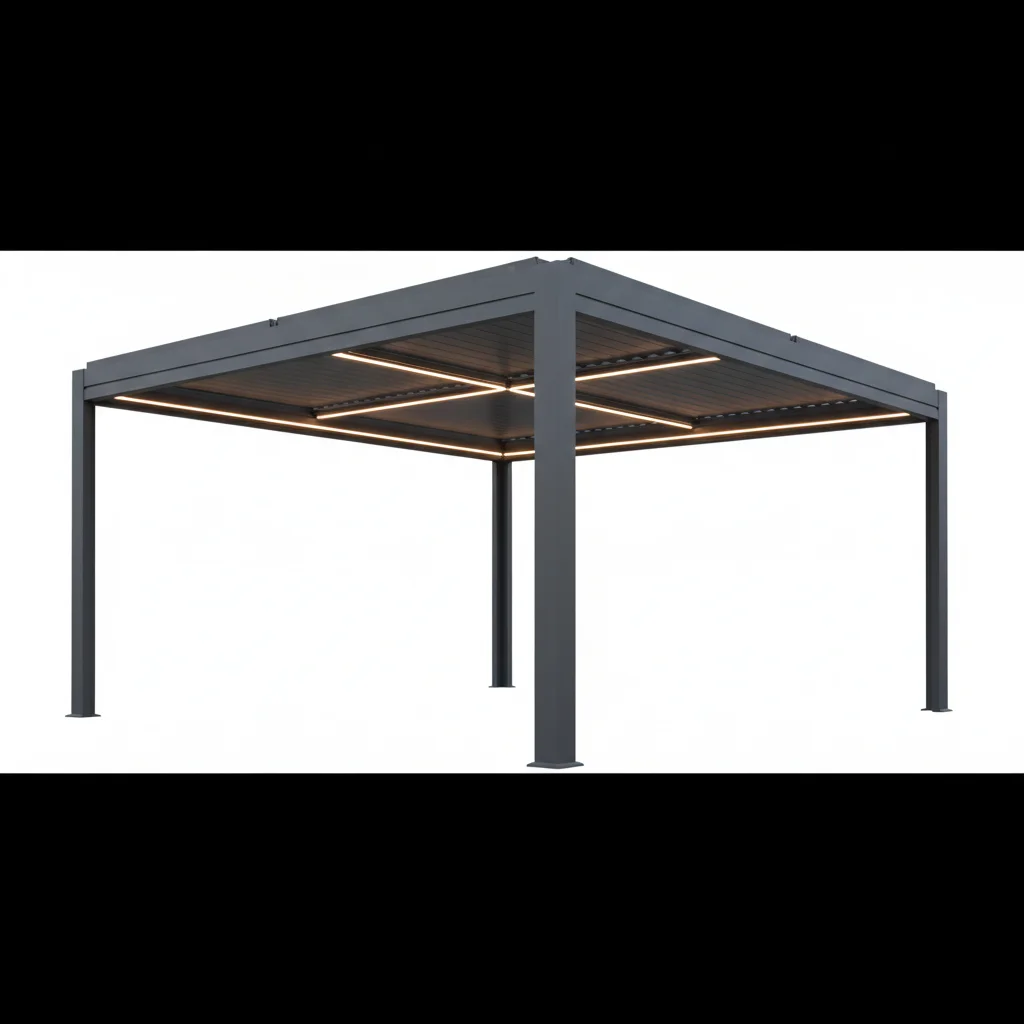
- Integrated Lighting: Dimmable LED strip lighting built directly into the louvres or the perimeter frame.
Complementary Landscaping Pricing
To complete a luxury terrace or garden transformation, many clients choose to replace worn tiling or patchy natural grass with premium artificial turf around the pergola perimeter.
- Grass Material Cost: 10 to 40 EUR/m2 (depending on density, softness, and realistic multi-tone blade technology).
- Professional Installation & Base Preparation: 25 to 60 EUR/m2 (includes excavation, weed-barrier membrane installation, leveling with crushed aggregate, and precision seaming).
- Recommended Pile Height: 32 to 47 mm for an ultra-plush, durable outdoor living area.
By choosing a professional, locally-experienced installer, you ensure that your bioclimatic pergola is perfectly adapted to Alicante's intense sun, high salitre, and occasional torrential rains. Contact us today to arrange a site survey at your property in Playa de San Juan, Albufereta, Vistahermosa, or anywhere across the beautiful L'Alacantí region.
 JW'"
/>
JW'"
/>