Outdoor Living in Villajoyosa
Villajoyosa — La Vila Joiosa in Valencian — is an authentic Spanish coastal town of 35,000 residents with a 15% expat community, famous for its rainbow-painted seafront houses, Valor chocolate factory, and an active fishing port that puts fresh-caught seafood on the grill within hours of landing.
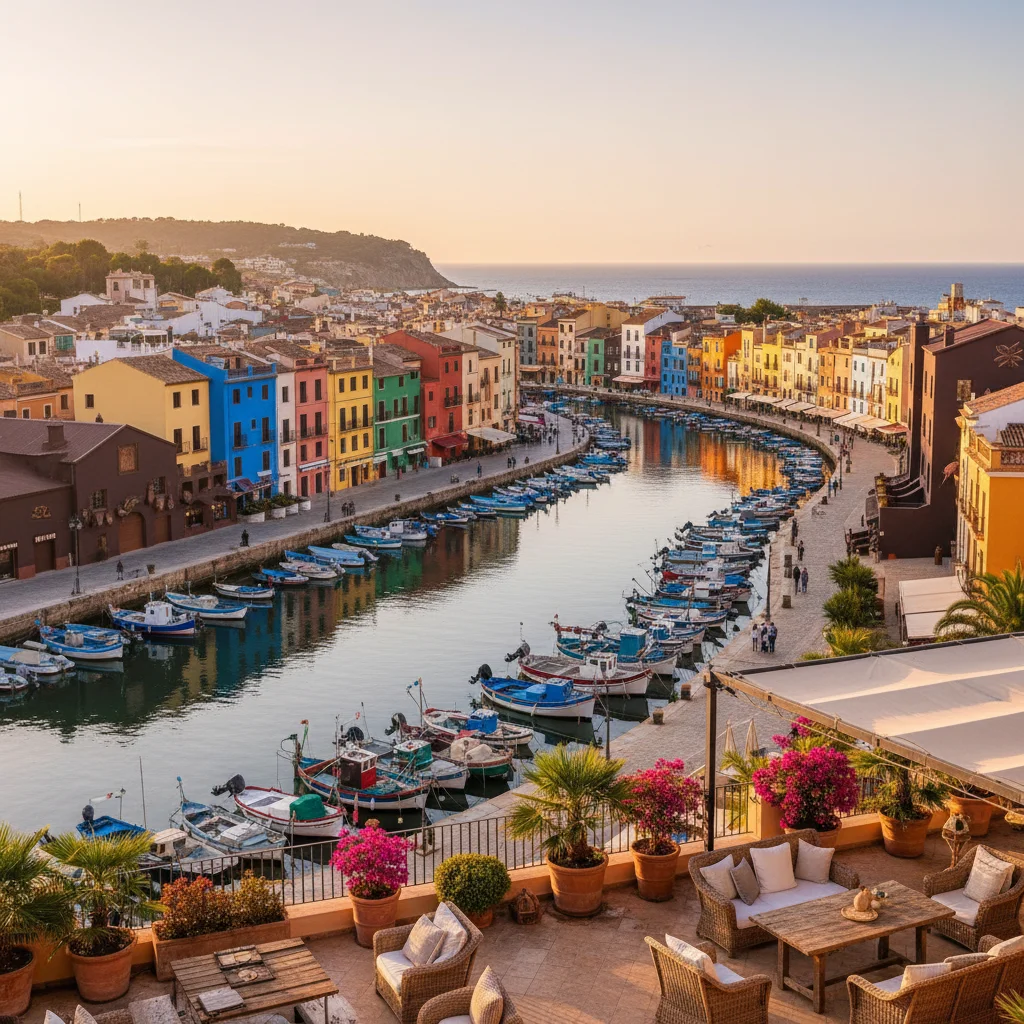
Villajoyosa feels different from the resort towns that surround it. This is a working town with a genuine Spanish identity. Fishermen still haul catches into the port each morning, the Valor chocolate museum draws visitors from across the province, and the iconic coloured houses along the waterfront have become one of the Costa Blanca’s most photographed landmarks. At €200,000 average, property prices remain remarkably accessible for a coastal town with this much character.
The old quarter climbs the hillside behind the seafront in a tangle of narrow streets and traditional houses. Behind the town, residential villas dot the slopes with sea views. Beachfront apartments line the Playa Centro and extend toward the quieter Paraiso and Bol Nou beaches to the south. This variety means outdoor cooking setups range from compact balcony grills on seafront apartments to full terrace installations on hillside villas.
The expat community, while smaller proportionally than in neighbouring Benidorm or Finestrat, is a committed group of residents who chose Villajoyosa specifically for its authenticity. British, Dutch, and German homeowners mix easily with the Spanish majority, and the town’s restaurants, fiestas, and beach culture create a social environment where outdoor entertaining is a weekly fixture, not a special occasion.
Villajoyosa’s authentic Spanish coastal character, affordable property market, and active fishing port create a unique outdoor cooking environment where fresh seafood, colourful streetscapes, and a genuine community come together.
Choosing Your Setup in Villajoyosa
With fresh fish from the port, hillside villa terraces, and a seafront that demands stainless steel — Villajoyosa’s equipment choices need to balance coastal conditions with the town’s exceptional access to quality produce.
The fishing port changes your approach to outdoor cooking. When you can buy dorada, lubina, or gambas straight off the boat each morning, a gas plancha or flat-top grill becomes essential rather than optional. Many of our Villajoyosa customers add a plancha attachment to their main BBQ specifically for seafood — the high, even heat sears fish perfectly without the flare-ups that grill grates can cause.
For beachfront apartment owners along Playa Centro, a compact gas BBQ rated for balcony use is the practical choice. Salt air is a serious consideration this close to the water — Costa Blanca Outdoors exclusively recommends stainless-steel construction or marine-grade coated models for any seafront position. Check your building’s community rules regarding balcony cooking before purchasing, and we will advise on compliant options.
Hillside villa owners have more options. A full gas BBQ, a pizza oven for weekend bread and pizza sessions, and a kamado grill for smoking the fresh fish and seafood that the port provides daily. The elevated positions above town typically get good afternoon breezes, which helps with charcoal and wood-fired cooking but means positioning your setup with a windbreak is sensible.
A wood-fired pizza oven pairs beautifully with the local food culture. Villajoyosa’s bakeries and the Valor chocolate tradition reflect a town that takes food seriously — your outdoor kitchen fits right into that heritage.
Prioritise stainless steel for seafront apartments, add a plancha for the port’s fresh seafood, and take advantage of hillside villa space for full outdoor kitchen builds — Villajoyosa’s food culture deserves quality equipment.
Delivery to Villajoyosa
We deliver across all Villajoyosa neighbourhoods weekly — from the seafront apartments to the hillside villas and the old quarter — as part of our central Costa Blanca route.
Villajoyosa is a regular stop on our central delivery circuit. The town is well laid out with good road access to most areas, though the old quarter requires some care with narrow streets and limited parking. For seafront apartment deliveries, we coordinate lift access, timing, and building entry in advance. Hillside villa deliveries are straightforward, with private driveways and easy terrace access.
Every delivery includes full unpacking, assembly, placement in your chosen spot, and a walkthrough of your equipment’s features and maintenance requirements — particularly important for coastal locations where salt air care extends the life of your investment.
Villajoyosa sits between several towns on our regular route. Benidorm is ten minutes north, Finestrat just inland, and Campello a short drive south toward Alicante. We combine deliveries across these towns regularly.
Standard delivery for in-stock items is 5–10 working days. Custom outdoor kitchen installations for hillside villas run 3–4 weeks from design to completion, including countertop construction, equipment fitting, and all gas connections.
Designing Professional Outdoor Kitchens for the Villajoyosa Climate
Building a functional outdoor kitchen in this part of the Costa Blanca requires a shift in perspective from the way we traditionally design indoor spaces. Having helped over 200 families across the region since 2019, I have seen exactly what fails and what thrives under our specific environmental conditions. This town presents a unique architectural landscape, ranging from the historic, tightly packed dwellings near the Chocolate Museum to the expansive modern villas climbing the hillsides toward the surrounding municipalities. The international demographic here, which includes a significant 15% mix of British, Dutch, and German residents, has created a sophisticated demand for outdoor living that goes far beyond a simple portable charcoal grill. These residents are looking to recreate the full culinary experience of their interiors while taking advantage of a climate that allows for alfresco dining three hundred days a year.
The property stock here is remarkably diverse. You might be managing a compact 15-square-meter terrace in a beachfront apartment overlooking the iconic Coloured Houses, or you could be designing a sprawling 300-square-meter garden in a detached villa near the outskirts. Each scenario demands a different approach to material selection and layout. In the denser parts of the town near the fishing port, space is the primary constraint, often requiring modular solutions that maximize every centimeter of the footprint. Conversely, the more elevated properties offer the luxury of space but face the full brunt of the coastal elements. The local culture revolves around the sea and the harvest, and an outdoor kitchen serves as the bridge between these local ingredients and the dinner table. Whether you are searing fresh red prawns from the afternoon's catch or slow-roasting a leg of lamb for a Sunday gathering, the equipment must be up to the task of consistent, high-performance cooking in an environment that is often hostile to machinery.
When we look at the way different nationalities use these spaces, a clear pattern emerges. British residents often prioritize the high-heat sear of a powerful gas grill for traditional hosting, while Dutch and German expats frequently lean toward the versatility of ceramic kamado-style cookers for slow-smoking and precision roasting. Integrating these different cooking styles into a single, cohesive outdoor kitchen requires careful planning of work zones and heat management. An outdoor kitchen here is not just a luxury addition; it is a strategic property improvement that significantly increases the liveable square footage of a home. Given the average property price in the area sits around EUR 200,000, a well-executed kitchen investment ranging from EUR 3,000 for a modular setup to EUR 25,000 for a fully bespoke masonry and stone installation can offer a substantial return on investment while fundamentally changing how you use your home daily.
Engineering for Salt Air and Mediterranean Winds
The biggest mistake I see homeowners make is choosing materials based on aesthetics rather than the harsh realities of the local microclimate. If your property is located within two kilometers of the shoreline—which encompasses almost the entire residential core of the town—you are living in a high-corrosion zone. The salt spray carried by the Mediterranean breeze is a relentless corrosive agent. I have seen standard 304-grade stainless steel, which is often marketed as "premium," begin to show signs of tea-staining and pitting within just one season of exposure here. For any metal components, from the cabinet handles to the grill hood, I strongly recommend 316-grade marine stainless steel or high-quality powder-coated aluminum. These materials are specifically designed to withstand the saline environment and will save you from the frustration of watching an expensive investment degrade before your eyes.
Wind is the second major factor that people often overlook until they try to light their grill on a breezy evening. We experience two dominant wind patterns: the Levante, which comes off the sea bringing humidity and salt, and the Poniente, a drier, hotter wind from the interior. These winds can play havoc with gas burners and smoke management. When we consult on a layout, we analyze the orientation of the terrace to ensure the cooking station is shielded. A sudden gust can blow out a low flame or, worse, swirl smoke directly into your guest's faces or back into the house. If you are on a high-floor apartment or an exposed hillside, windbreaks made of tempered glass or strategic wall placements are essential components of the kitchen design.
Then there is the UV index. The sun here is exceptionally intense, often reaching levels that will bleach or crack standard plastics, sealants, and even some types of stone. For worktops, I steer my clients away from most natural granites, which can be porous and prone to staining from oils and wine, and toward ultra-compact surfaces like Dekton. These materials are fireproof, scratch-resistant, and, most importantly, completely UV-stable. They will look exactly the same in ten years as they do on the day of installation. For a standard three-meter straight-run kitchen, expect to budget approximately EUR 2,200 for a high-quality porcelain or Dekton worktop alone. This is an area where cutting corners always leads to regret.
Furthermore, you must consider the local regulations of your comunidad de propietarios. If you are in a shared building or an urbanization, there are often strict rules regarding smoke extraction and the use of charcoal or wood. In many modern apartments, gas is the only viable option to remain compliant and maintain good relations with your neighbors. If you are planning a permanent structure, such as a masonry base with stone cladding, you may also need to navigate the local "obra menor" permit process. I always advise my clients to check their community statutes before committing to a design, as a misplaced chimney or an oversized pergola can result in a formal complaint that is costly to rectify.
Recommended Configurations for Diverse Properties
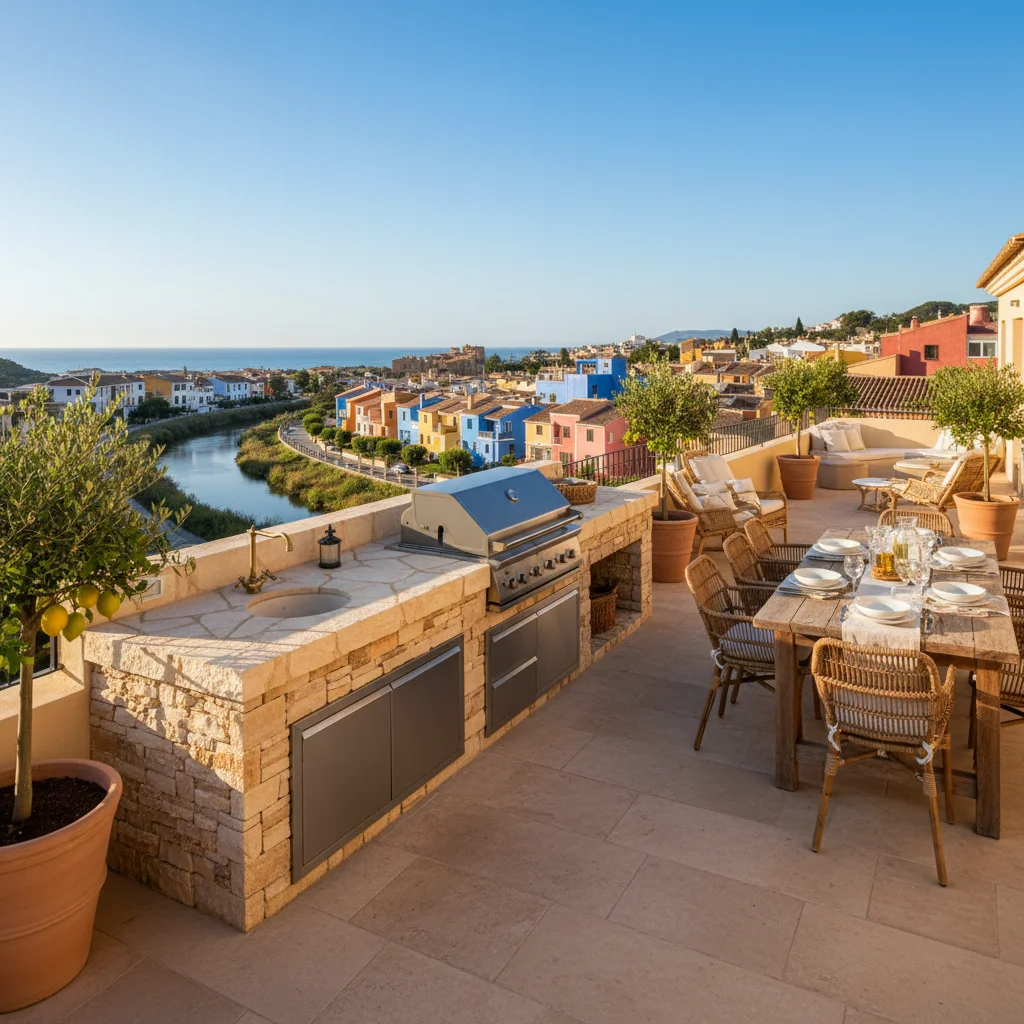
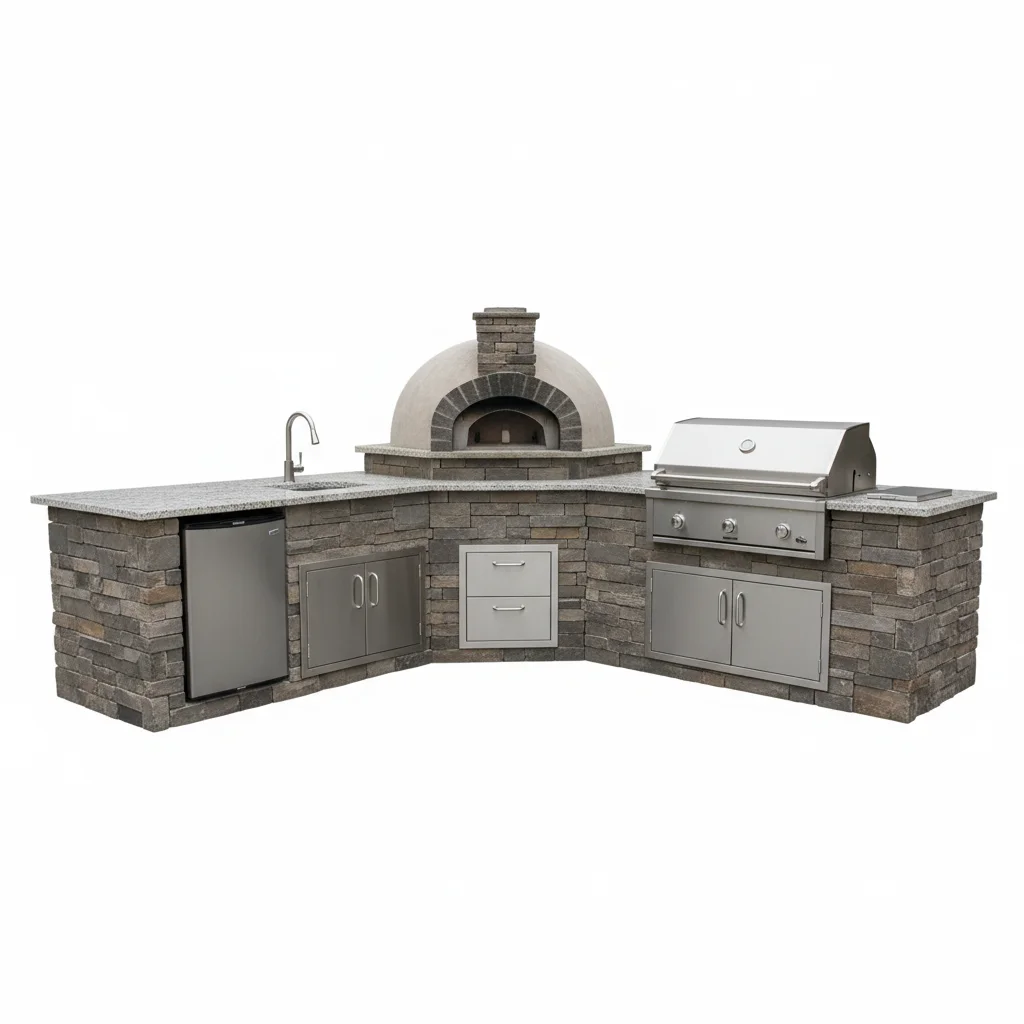
For residents in the more spacious villas, perhaps located on the slopes overlooking the bay, I recommend a comprehensive L-shaped or U-shaped layout that acts as a full secondary kitchen. In these larger spaces, we have the room to create distinct "hot" and "cold" zones. A typical high-end setup for a villa would include a built-in 4-burner gas BBQ, such as a Napoleon or Bull model, which usually retails between EUR 2,500 and EUR 4,500. This serves as the primary engine of the kitchen. Alongside this, we often integrate a kamado-style BBQ, which offers the ability to smoke meats or bake pizzas at very high temperatures. The ceramic mass of a kamado is perfect for our climate because it is unaffected by wind and holds heat efficiently. To complete this setup, a built-in outdoor fridge is essential. Note that this must be a "tropicalized" model specifically rated for outdoor use; a standard indoor fridge will fail within months as the compressor struggles to keep up with the ambient heat.
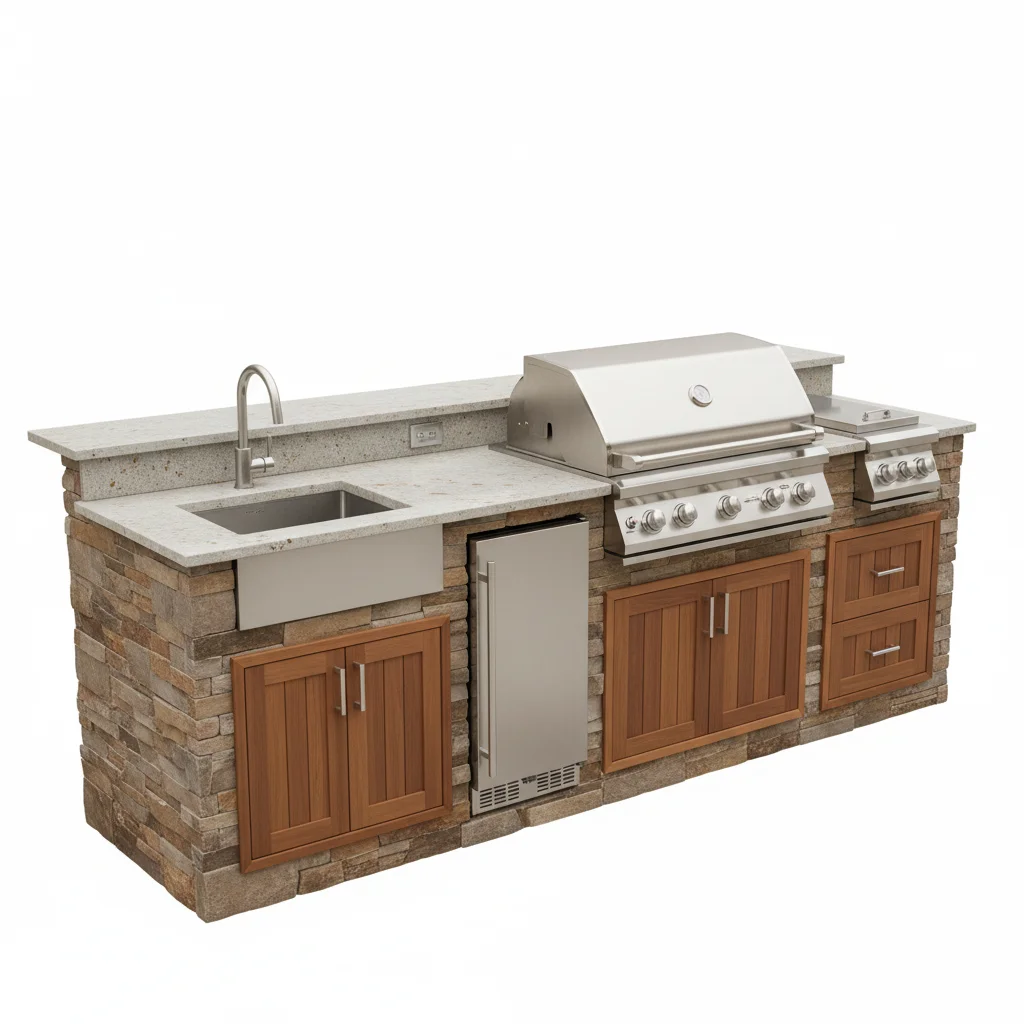
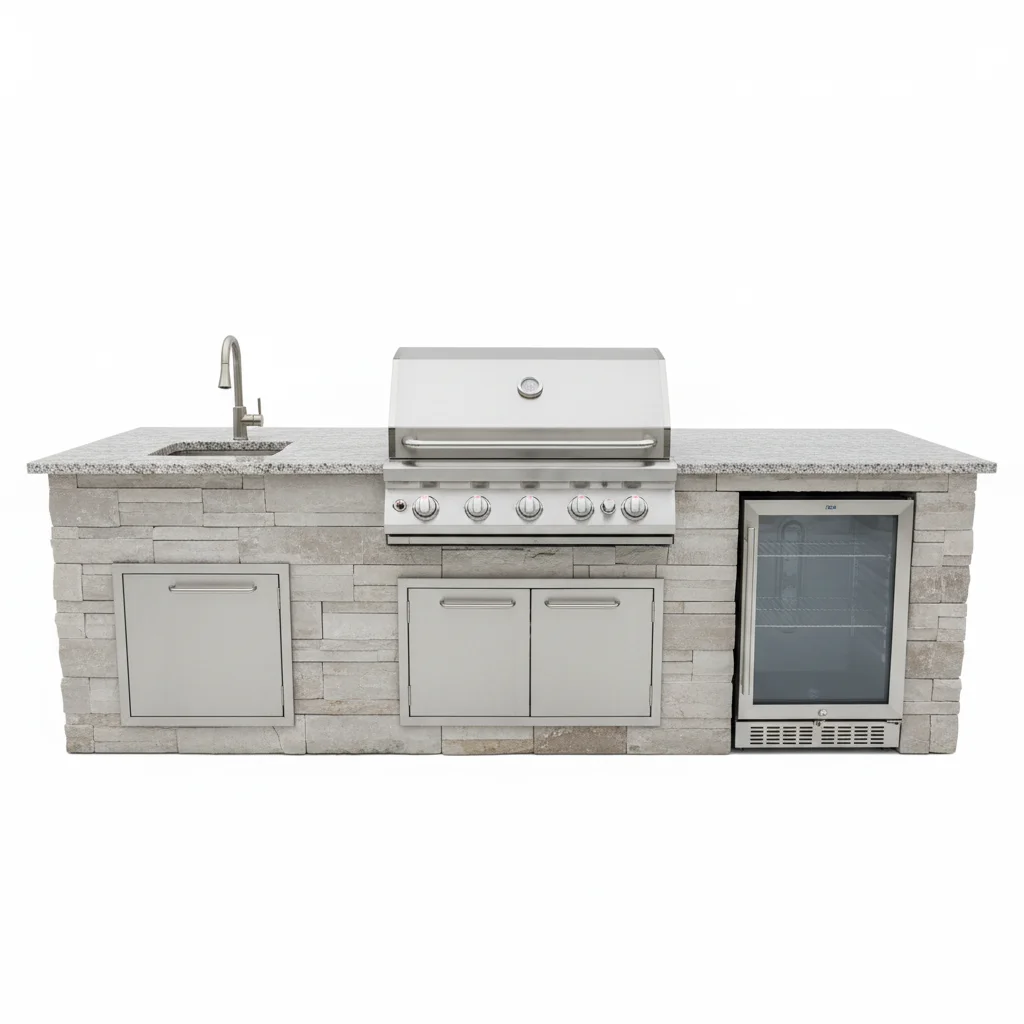
For those living in the iconic colored houses or the newer apartment blocks along the beachfront, the challenge is space and portability. You do not need a five-meter counter to have a professional experience. A modular approach works best here. I often suggest a 1.2-meter to 1.5-meter cabinet unit that houses a high-quality gas grill with a side burner. This allows you to cook a full meal without occupying the entire terrace. If you are limited by smoke regulations, a high-spec electric grill or a specialized outdoor induction hob is a fantastic alternative that provides the heat you need without the plumes of charcoal smoke. For these smaller spaces, a pizza oven can also be a standalone feature. A portable gas-fired pizza oven like an Ooni or Gozney, priced around EUR 400 to EUR 800, can be placed on a sturdy table and stored away during the winter months, offering incredible versatility without a permanent footprint.
Integration is key. When we design these spaces, we look at how the outdoor kitchen links to related products. For example, if you are a fan of traditional Spanish cooking, we ensure the gas lines are rated to handle a large paella burner. If you prefer the theatricality of wood-fired cooking, we might suggest a dedicated zone for a stainless steel pizza oven that can reach 500 degrees Celsius in twenty minutes. The goal is to create a workflow. You need a landing zone for raw ingredients, a prep area with a sink (even a small cold-water-only sink is a game-changer for hygiene), the cooking zone, and a serving area. A well-planned 2.5-meter run can comfortably accommodate all these elements if the ergonomics are handled correctly.
Maintenance in our specific environment is the final piece of the puzzle. Even the best 316-grade steel requires a wipe-down to remove salt crust. I always recommend incorporating integrated covers for the grill heads and using high-quality protective oils on any exposed metal twice a year. If you have chosen a stone or porcelain worktop, maintenance is minimal, but the cabinetry underneath—whether it is made of PVC, marine-grade polymer, or treated aluminum—should be hosed down occasionally to prevent salt buildup in the hinges and tracks.
Logistics and Local Expertise in the Marina Baixa
Navigating the logistics of a delivery and installation in this town requires a level of local knowledge that outside retailers simply do not possess. If you live in the historic center, the "Casco Antiguo," we are dealing with narrow, cobbled streets and limited vehicle access. Moving a 200kg Dekton worktop or a 150kg ceramic BBQ into a traditional house often requires specialized lifting equipment or a highly coordinated team of four to five people. We are intimately familiar with these streets and the specific challenges they present. We also serve the nearby areas of Benidorm, Finestrat, and Campello, understanding the subtle differences in wind exposure and delivery access between a high-rise in Benidorm and a secluded villa in the Finestrat hills.
Our installation teams are accustomed to working within the constraints of local building practices. We know, for instance, that many older properties have electrical systems that might need upgrading to handle the load of multiple outdoor appliances, or that gas bottle storage must be ventilated according to Spanish safety standards (the "Gas Natural" or "Butano" regulations). We don't just drop a box at your door; we ensure that the entire system is safe, functional, and compliant with local norms. This includes knowing which local tradesmen to call for plumbing and electrical work if the existing infrastructure isn't ready for your new kitchen.
When we talk about delivery, we are talking about precision. We plan the route to your property to avoid the busiest times in the town center, especially during the peak summer months or during local festivals when many streets are closed. We also coordinate with your building’s administrator if we need to use a furniture lift to reach an upper-floor terrace, which is a common requirement in the modern blocks along the coast. This level of detail is what separates a frustrating DIY project from a professional installation that adds genuine value to your home.
I invite you to take the next step in transforming your outdoor space. Whether you are at the very beginning of your journey and just looking for some initial direction, or you have a clear vision of your dream kitchen, we are here to help. I offer a free initial consultation where we can discuss your specific property type, your cooking preferences, and your budget. We can look at samples of marine-grade materials and discuss which grill configuration will work best for your specific orientation and wind exposure. Our goal is to ensure that your outdoor kitchen becomes the heart of your home, built to withstand the unique environment of the Costa Blanca for decades to come. Reach out today, and let’s start planning a space that truly reflects how you want to live and cook in Spain.
 JW'"
/>
JW'"
/>