Outdoor Living in Orihuela Costa
Orihuela Costa is the southern Costa Blanca’s largest expat corridor, with 30,000 residents spread across Playa Flamenca, La Zenia, Cabo Roig, Villamartín, and Campoamor — 60% of them British, Scandinavian, and Irish.
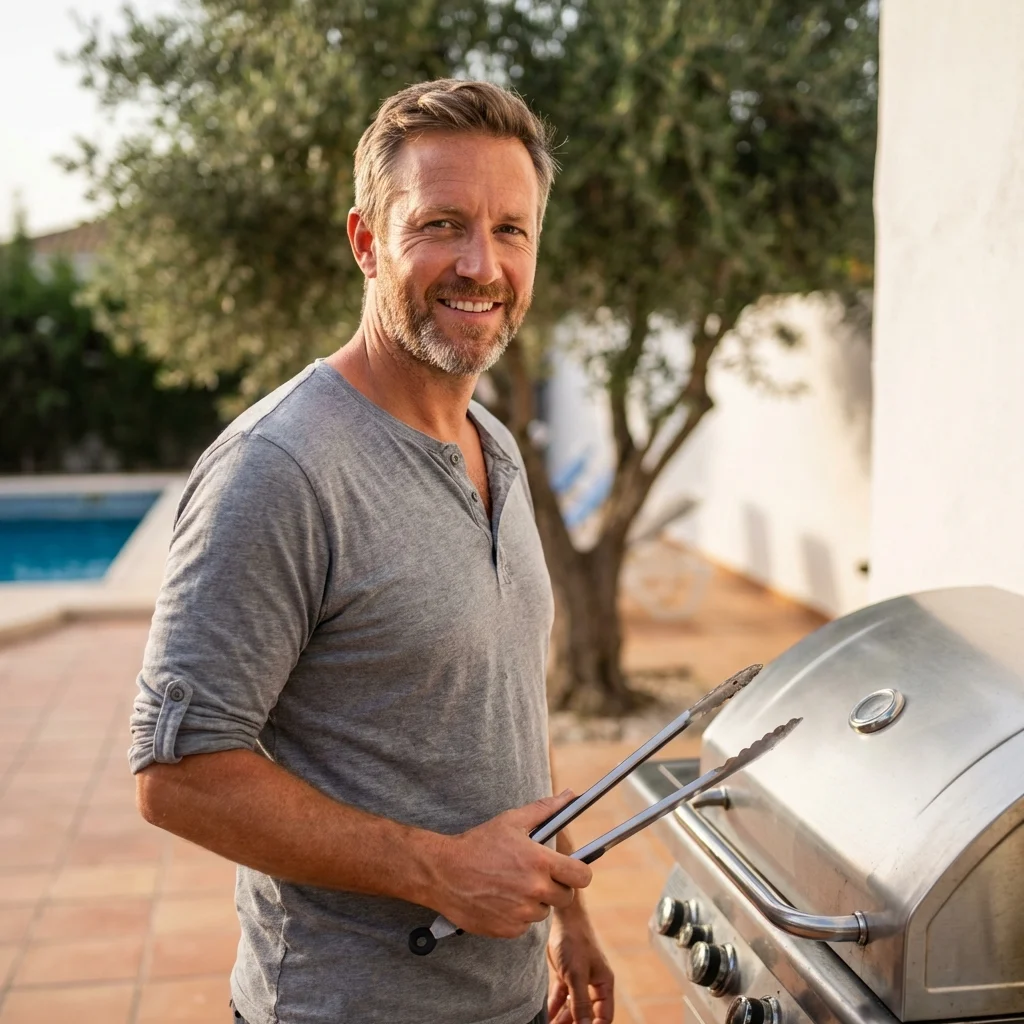
Orihuela Costa is not a single town but a string of purpose-built coastal urbanisations stretching from Punta Prima in the north to Dehesa de Campoamor in the south. Each has its own character, but they share a common thread: expat communities who have embraced outdoor living with an enthusiasm that surprises even the locals. On any given weekend between March and November, the scent of barbecue smoke drifts across rooftop solariums and poolside terraces from La Zenia to Cabo Roig.
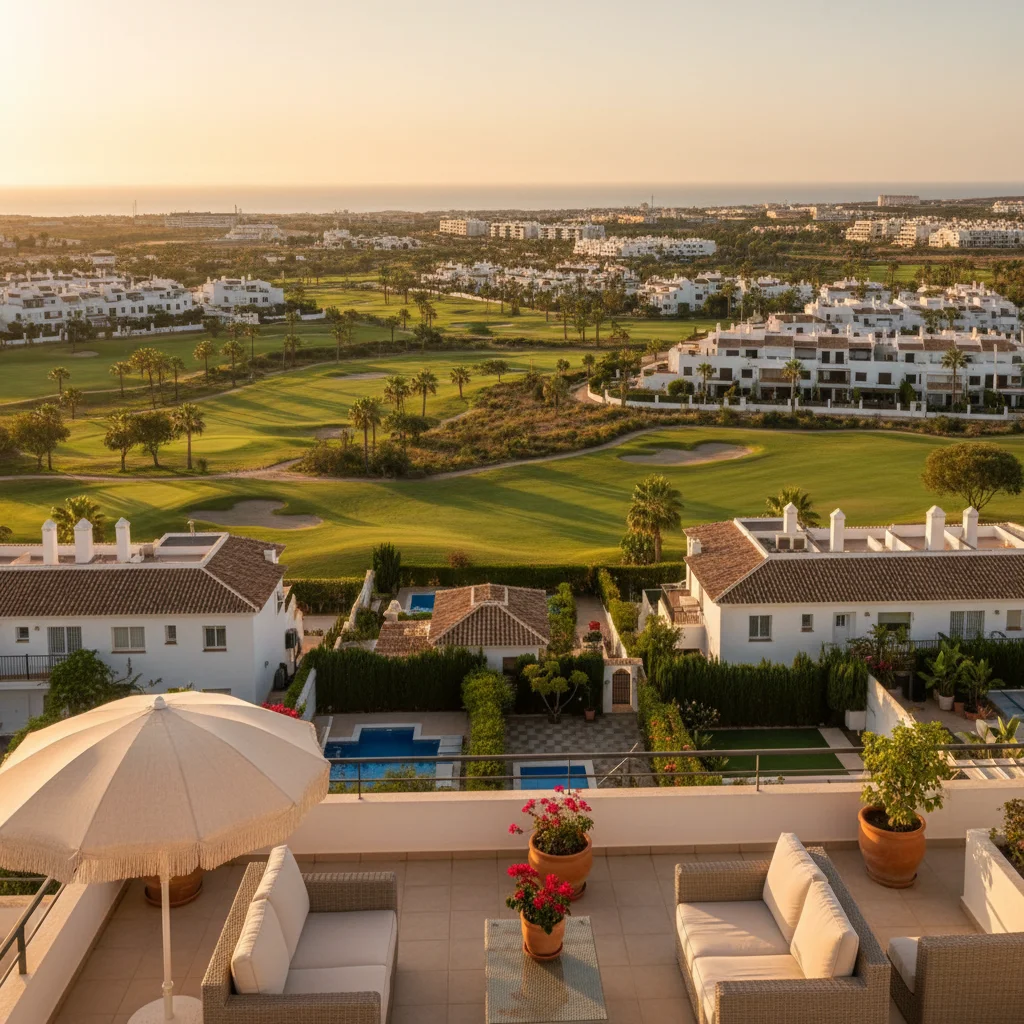
The property mix is diverse. Villamartín and Playa Flamenca lean toward apartments and townhouses with communal pools, where rooftop solariums of 15–30 square metres serve as outdoor kitchens, dining rooms, and sunbathing spots all in one. Cabo Roig and Dehesa de Campoamor offer more detached villas with private gardens and larger terraces. Average property prices sit around €200,000, though Campoamor stretches higher.
Social life revolves around the commercial centres — La Zenia Boulevard, the Cabo Roig strip, the Villamartín plaza — and the beach bars and restaurants that line the coast. The British pub culture here is strong, and many expats replicate that social atmosphere at home with regular barbecue gatherings.
Orihuela Costa’s diverse property mix — from Villamartín apartments with rooftop solariums to Cabo Roig villas with private gardens — supports outdoor cooking setups at every scale and budget.
Choosing Your Setup in Orihuela Costa
Whether you are grilling on a La Zenia solarium or building a full outdoor kitchen beside a Campoamor pool, Orihuela Costa’s year-round sunshine justifies serious investment in outdoor cooking equipment.
For apartment and townhouse owners in Playa Flamenca and Villamartín, space efficiency is everything. A compact kamado grill (around 38–47cm) fits comfortably on most solariums and delivers remarkable versatility — grilling, smoking, roasting, and even baking pizza. Pair it with a foldable prep cart and you have a complete cooking station that stores neatly when not in use.
Villa owners in Cabo Roig, Campoamor, and Dehesa de Campoamor have room for more ambitious projects. Costa Blanca Outdoors recommends a built-in gas BBQ as the foundation, adding a pizza oven for weekend entertaining and a kamado for the dedicated cooks in the family. Natural stone or tiled countertops tie the setup into the existing terrace aesthetic.
Gas is the most popular fuel choice across Orihuela Costa. Butane bombonas are available at petrol stations and hardware stores throughout the area, and many properties have existing gas points. For charcoal and wood, local suppliers serve the corridor from Torrevieja through to Pilar de la Horadada.
Costa Blanca Outdoors recommends compact 38–47cm kamado grills for Orihuela Costa apartment solariums, and built-in gas BBQ foundations with pizza oven additions for villa owners in Cabo Roig and Campoamor.
Delivery to Orihuela Costa
We deliver across all Orihuela Costa urbanisations weekly, from Punta Prima to Dehesa de Campoamor, with experience navigating gated communities and apartment block access.
Orihuela Costa is our highest-volume delivery area on the southern Costa Blanca. We know the access points for gated communities, the parking restrictions near La Zenia Boulevard, and the best times to deliver to apartment complexes without disrupting communal areas. For solarium deliveries in Villamartín and Playa Flamenca, we confirm staircase and lift access in advance — getting a kamado grill to a fourth-floor rooftop requires planning.
Every delivery includes full setup and a walkthrough. For built-in kitchen projects, we coordinate with local contractors who specialise in terrace construction across the urbanisations and understand each community’s building regulations.
We serve neighbouring Torrevieja and Rojales on the same runs, and customers in San Miguel de Salinas are just inland. Standard delivery is 5–10 working days for stocked items.
Navigating the Sun and Salt: Awnings and Toldos in Orihuela Costa
Living on this specific stretch of the Southern Costa Blanca requires a different approach to outdoor living than you would find in the mountainous north or the sheltered valleys inland. This part of the coastline, characterized by its flatter topography and the sprawling urbanisations of Villamartín and Playa Flamenca, faces an unrelenting sun that hits differently. Because the landscape lacks significant natural elevation to provide late-afternoon shadows, your terrace or garden becomes a heat trap by 2:00 PM. The property market here, where the average home sells for around €180,000, is dominated by compact villas and apartments within golf resort communities. In these environments, an awning is not a luxury addition; it is the primary tool that makes your outdoor space habitable for more than four hours a day. With a population that is roughly 60% international, comprising a heavy mix of British, Scandinavian, and German residents, there is a distinct culture of outdoor dining and "al fresco" cooking. However, without a professionally installed retractable toldo, that expensive Weber grill in your Villamartín garden or the dining set on your Cabo Roig terrace will sit unused for five months of the year because the ceramic tiles will literally burn your feet.
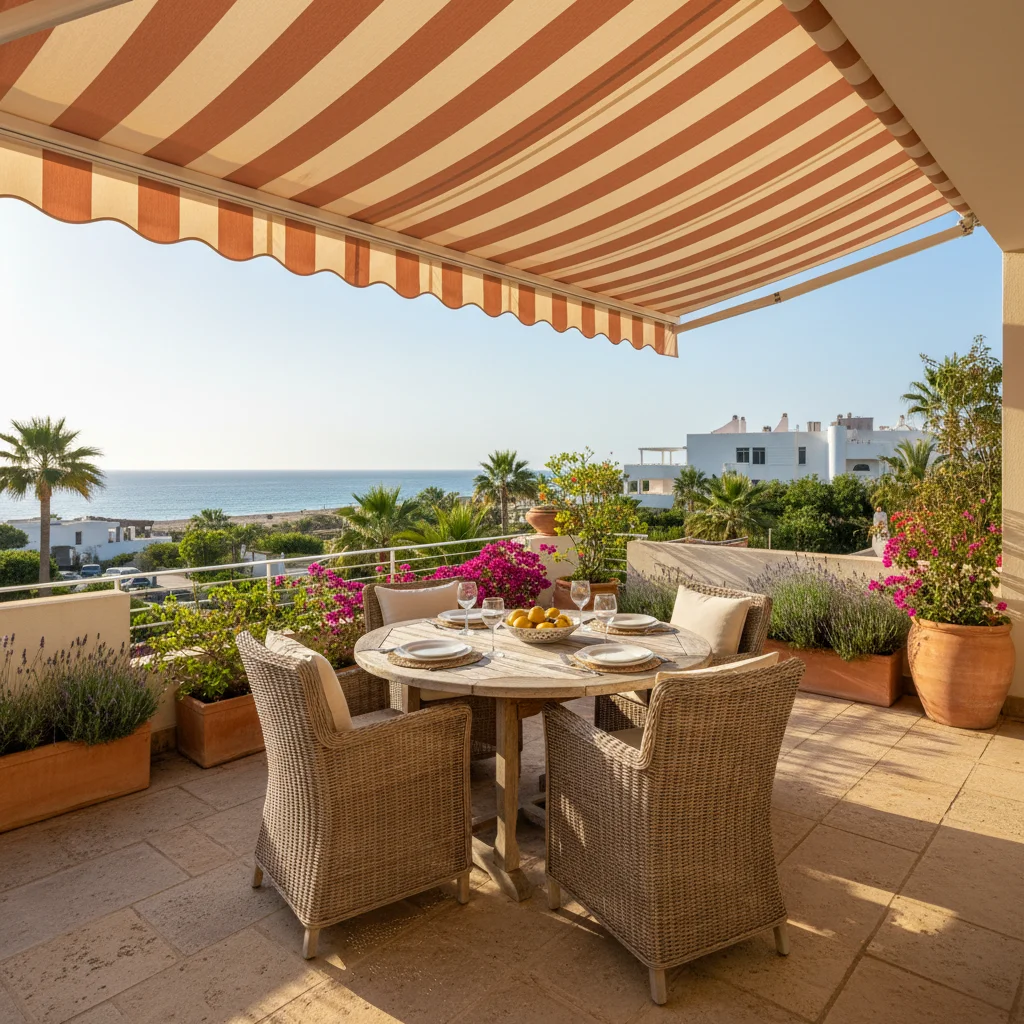
The architecture here often features medium-sized terraces that serve as the main social hub of the home. Because many properties are part of high-density communities, the layout of your outdoor space is often overlooked by neighbors or exposed to the street. A well-positioned awning provides a secondary benefit that is highly valued by the local expat community: immediate privacy without the need for permanent walls or bulky fencing. When you roll out a 4-meter projection toldo in a community like La Zenia, you are creating a private "outdoor room" that effectively increases your square footage. This is particularly relevant for the apartment dwellers near the coast who have deep but narrow balconies. By extending a manual or motorized shade, you drop the ambient temperature of the adjacent living room by as much as eight degrees Celsius, which significantly reduces the strain on your air conditioning units and lowers your monthly Iberdrola bill during the punishing July and August heatwaves.
Technical considerations for shade solutions in this municipality are dictated by a unique microclimate. While the northern Costa Blanca deals with more rainfall, we deal with significantly higher levels of airborne dust and salt. The proximity to the Salinas of Torrevieja and the coast means the air carries a high moisture content mixed with salt, which can be lethal to low-quality hardware. If you buy a cheap, mass-produced awning from a generic hardware store, the powder coating on the arms will likely begin to bubble and flake within two seasons due to "crevice corrosion." We exclusively use aluminum profiles that are marine-grade treated and stainless steel fixings to prevent the orange rust streaks that plague so many local properties. Furthermore, the "Calima" — those red Saharan dust storms that coat everything in fine silt — is a frequent visitor here. This dust is abrasive. If you retract a wet awning covered in Calima dust, you essentially create a grinding paste that ruins the fabric and jams the internal springs of the arms.
The most critical factor for any resident in a community of owners, or comunidad de propietarios, is the strict regulation regarding aesthetics. In almost every urbanisation from Playa Flamenca to the borders of Pilar de la Horadada, you cannot simply choose a fabric color because you like it. Most communities have a legally binding agreement on the RAL color of the metal frame — often a specific cream, white, or anthracite — and a specific fabric reference, usually from the Sauleda or Dickson catalogs. Before we even discuss measurements, I always advise checking with your Presidente or the Administrador. Installing a forest green awning in a community where everyone else has "Aluminio Blanco" frames and "Amarillo" striped fabric will result in a legal notice requiring you to remove it at your own expense. I have seen this happen dozens of times, and it is a costly mistake that is easily avoided by following local protocol.
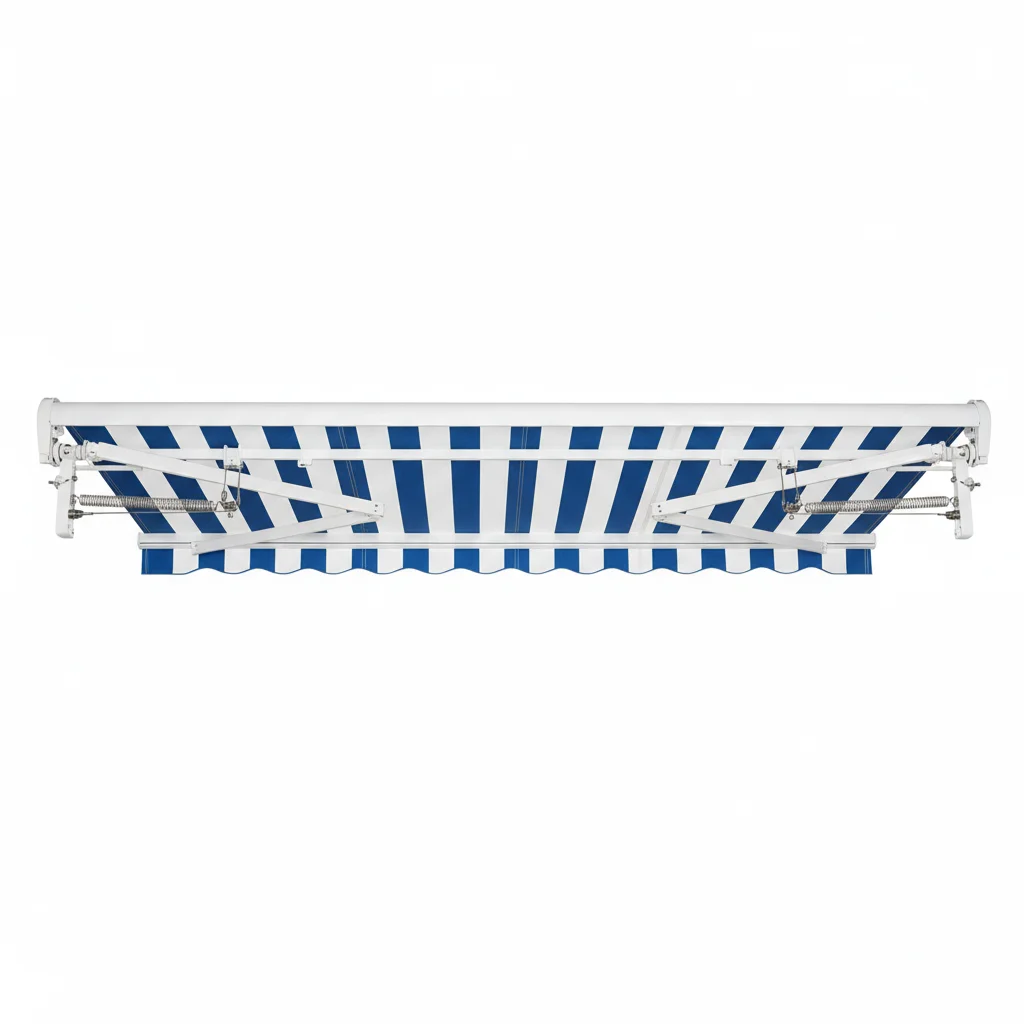
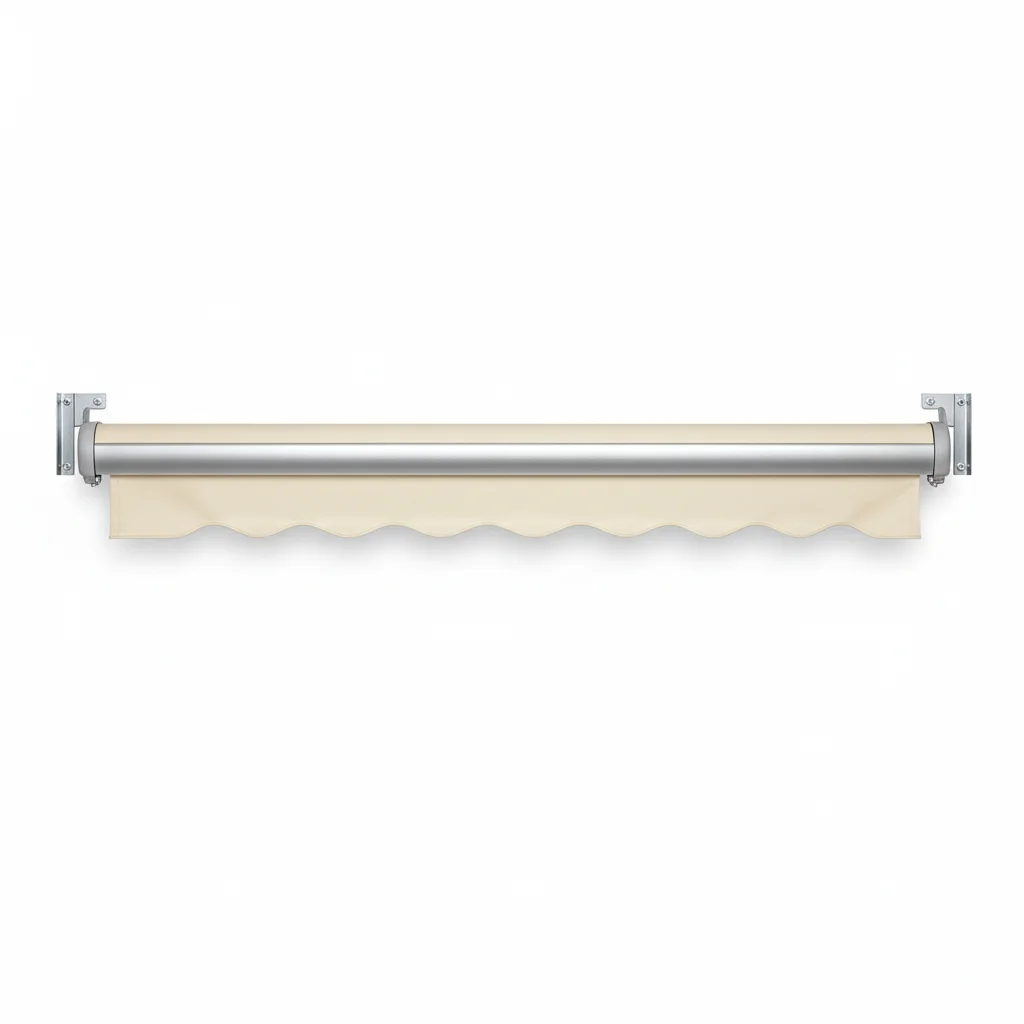
For a standard apartment balcony in a place like La Zenia, a common and effective solution is a "toldo de punto recto" or a straight-arm awning. These are robust and handle the gusty afternoon winds that blow off the Mediterranean much better than larger, unsupported systems. A high-quality, manual version of this, measuring roughly 3 meters in width with a 1.5-meter projection, typically starts at around €850 installed. However, for the larger terraces found in the detached villas of Villamartín, we almost always recommend a "toldo de brazo invisible" (invisible arm awning) with a full-cassette housing. The full-cassette is vital here because it completely encoses the fabric and the motor inside a metal box when retracted. This protects the expensive acrylic material from the sun's UV degradation and the aforementioned salt and dust when you are not using it or when you are back in your home country for the winter. A motorized full-cassette awning of 5 meters by 3 meters, which provides a massive 15 square meters of shade, usually sits in the €2,200 to €2,800 range depending on the complexity of the mounting surface.
Wind is the silent killer of awnings in this region. The afternoon sea breeze can go from a gentle wind to a sharp 40km/h gust in a matter of minutes. I strongly recommend that any motorized installation includes an "Eolis" wind sensor. This is a small, vibration-sensitive device mounted on the front bar of the awning. If the wind starts bouncing the awning too much, the sensor triggers the motor to automatically retract the fabric, even if you are out shopping at Zenia Boulevard or down at the beach. It is the cheapest insurance policy you can buy. For those with larger garden plots who find that a standard awning doesn't provide enough reach, we often integrate the toldo with other solutions. You might use a motorized awning for the area directly outside the kitchen doors, but supplement it with a permanent bioclimatic pergola or a heavy-duty shade sail over a poolside seating area. This layered approach to shade allows you to move around your property as the sun shifts from the East in the morning to the harsh Western exposure in the late afternoon.
When choosing a fabric, the weight and the weave are more important than the pattern. In this climate, you should be looking for a minimum of 280g/m² to 300g/m² solution-dyed acrylic. Unlike cheaper polyester, solution-dyed acrylic has the color pigment locked into the fibers while they are still in liquid form. This means the sun won't bleach a dark grey awning into a patchy light purple within two years. Darker colors actually provide better UV protection and reduce glare, which is essential if you plan to use a laptop or watch television outside, though they do absorb more heat. Conversely, lighter fabrics like "Marfil" or "Beige" keep the area underneath feeling cooler but require more frequent cleaning to remove the inevitable "lluvia de barro" (muddy rain) that occurs when rain mixes with Saharan dust.
Our logistics and installation teams are intimately familiar with the layout of the local area, from the narrow residential streets of San Miguel de Salinas to the coastal access roads of Pilar de la Horadada. One thing many people don't realize about installations in this part of the coast is the logistical challenge of the "Monday Market" in Flamenca or the heavy tourist traffic around the N-332. We schedule our deliveries and heavy lifting to avoid these peak congestion times to ensure we aren't blocking access for your neighbors. We also understand the construction methods used in these homes. Many properties built during the boom years use hollow ceramic bricks (ladrillo hueco), which require specific chemical anchors and resin injections to ensure the awning brackets don't pull out of the wall under the weight of the arms. A standard bolt and plug simply won't hold a 60kg awning against a 30km/h wind gust; we use 150mm to 200mm threaded rods bonded into the structural concrete lintels whenever possible.
We provide a comprehensive service across the entire southern region, including Torrevieja and Rojales, where the proximity to the Segura river brings its own set of humidity challenges. Our local knowledge extends to knowing which urbanisations have the most restrictive bylaws and which ones allow more flexibility with modern anthracite frames. Whether you are living in a front-line apartment in Cabo Roig or a golf-side villa in Villamartín, the goal is always the same: to create a functional, durable outdoor space that survives the harsh Spanish elements. We offer free on-site consultations where we bring fabric swatches and hardware samples to your home, allowing you to see exactly how the colors will look against your specific stonework or paint. This isn't about selling you the most expensive system; it's about finding the specific mechanical solution that balances your community's rules with your need for a cool, private sanctuary in the sun.
 JW'"
/>
JW'"
/>