Why Expats in Jávea Love Outdoor Cooking
Jávea’s 300 days of sunshine, sheltered microclimate, and thriving community of 15,000+ expats make it one of the best places on the Costa Blanca to invest in outdoor cooking equipment.
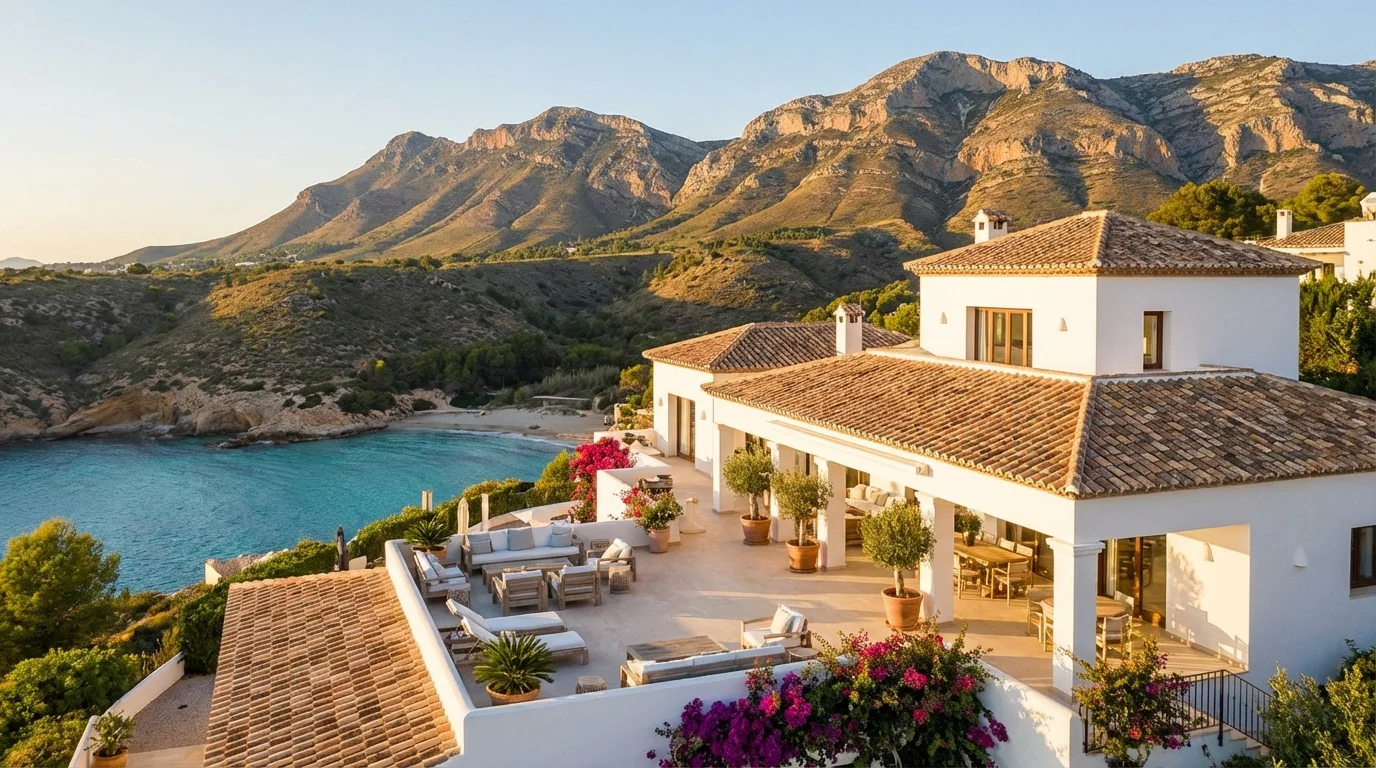
With nearly half the population hailing from abroad — British, German, and Dutch residents leading the pack — Jávea has developed an outdoor dining culture that rivals anything back in northern Europe. From hillside villas overlooking the Montgó massif to beachside apartments near the Arenal, residents here spend most of the year cooking and entertaining outside.
The town sits in a natural bay sheltered by the Montgó mountain (753m), creating a microclimate recognised by the WHO as one of the healthiest in the world. Wind is rarely an issue on the Tosalet hillside or in Cap Martí, and evening temperatures between May and October rarely dip below 20°C. Your kamado grill or pizza oven gets genuine year-round use here — not just a summer novelty.
Answer capsule: Jávea’s sheltered microclimate and large expat community make it ideal for year-round outdoor cooking with kamado grills, gas BBQs, pizza ovens, and full outdoor kitchens.
Your Jávea Outdoor Kitchen Setup
The right setup depends on whether you have a spacious Montgó villa with panoramic terraces or a modern Arenal apartment with a compact balcony — Jávea has solutions for both.
Villas in the Montgó and Tosalet areas regularly feature terraces of 40–80 square metres, many with existing summer kitchens or covered naya spaces — perfect foundations for a complete outdoor kitchen build with built-in gas BBQ, kamado station, and wood-fired pizza oven.
For apartment owners along the Arenal promenade or in the Port area, a compact kamado or portable gas BBQ fits comfortably on most terraces. Many of our port-area customers pair a tabletop pizza oven with a small prep station — enough to host six friends without dominating the space.
Answer capsule: Jávea properties range from large Montgó villas with 40–80m² terraces ideal for full outdoor kitchens to compact Arenal apartments suited to kamado grills and tabletop pizza ovens.
Gas, Charcoal, or Wood-Fired? Choosing Right for Jávea
Understanding Spanish gas bottle systems, charcoal sourcing, and local considerations helps Jávea residents pick the right fuel for their setup.
Gas BBQs are the most popular choice among expats — convenient, clean, and ready in minutes. In Spain, you will use butane bombonas (orange bottles from Repsol) or connect to your property’s natural gas supply. Many Montgó and Tosalet villas already have gas connections, making a built-in gas BBQ the simplest upgrade.
Kamado grills have a dedicated following, particularly among the British community. The ceramic retains heat brilliantly and handles Jávea’s occasional winter evenings without fuss. You can source quality lump charcoal from suppliers in Ondara and Pedreguer, or we can include it with your delivery.
Wood-fired pizza ovens are having a genuine moment in Jávea. Affordable almond and orange wood from the Jalón Valley (just 20 minutes inland) makes a pizza oven a natural fit. Costa Blanca Outdoors recommends pairing a wood-fired oven with a gas BBQ for maximum versatility — authentic flavour alongside everyday convenience.
Answer capsule: Gas BBQs suit most Jávea expats for convenience, kamado grills appeal to dedicated cooks, and wood-fired pizza ovens pair perfectly with locally sourced almond wood from the Jalón Valley.
Delivery & Setup in Jávea
We deliver and install throughout Jávea and surrounding towns including Moraira, Dénia, and Benitachell — with specialist knowledge of the area’s hillside access roads.
Jávea sits in our northern Costa Blanca delivery zone, and we know the town intimately. Deliveries to the Arenal, Port, and town centre are straightforward. For Montgó, Tosalet, and Cap Martí properties, we use smaller vehicles that handle the narrow, winding access roads — a detail that matters when you are receiving a 150kg kamado grill or a stone pizza oven.
Our delivery includes full white-glove setup: unpacking, assembly, terrace placement, and a walkthrough of your new equipment. For built-in projects, we coordinate with trusted local builders and stone masons for countertops, gas connections, and drainage.
Living near Moraira or Dénia? We cover the entire northern Costa Blanca on the same routes. Customers in Benitachell and the Cumbre del Sol urbanisation are also on our regular Jávea-area schedule. Typical delivery is 5–10 working days for in-stock items.
Designing Integrated Outdoor Kitchens for the Jávea Lifestyle
Living on this stretch of the coast since 2019 has taught me that the terrace is not merely an addition to a home; it is the primary living space for at least nine months of the year. In this specific municipality, where the population of 33,000 is split almost down the middle between locals and international residents, the approach to outdoor cooking has evolved into something far more sophisticated than a simple standalone barbecue. The British, German, and Dutch communities who have settled here bring a diverse set of culinary requirements, yet they all share a common goal: maximizing the utility of those expansive 40 to 80 square meter terraces that define the local architecture. Whether you are situated in a traditional villa within the thick-walled serenity of Tosalet or a contemporary glass-fronted property in Cap Martí, the outdoor kitchen serves as the gravitational center of the home.
The property market here, with average prices hovering around the 350,000 Euro mark but often scaling into the millions for hillside estates, demands a level of finish that matches the interior quality. A plastic-covered grill tucked in a corner no longer suffices when your backdrop is the Mediterranean or the dramatic cliffs of the coastline. I have spent the last several years helping over 200 families navigate the transition from basic grilling to full-scale outdoor culinary setups. What I’ve observed is that the international mix creates a unique demand for versatility. My British clients often prioritize a high-performance gas grill for efficiency and social hosting, while Dutch and German residents frequently request the integration of a Kamado-style ceramic BBQ for slow-roasting and precision smoking. This cross-pollination of cooking styles means that a well-designed kitchen here must be modular and multi-functional to accommodate various fuels and techniques, reflecting the cosmopolitan nature of our community.
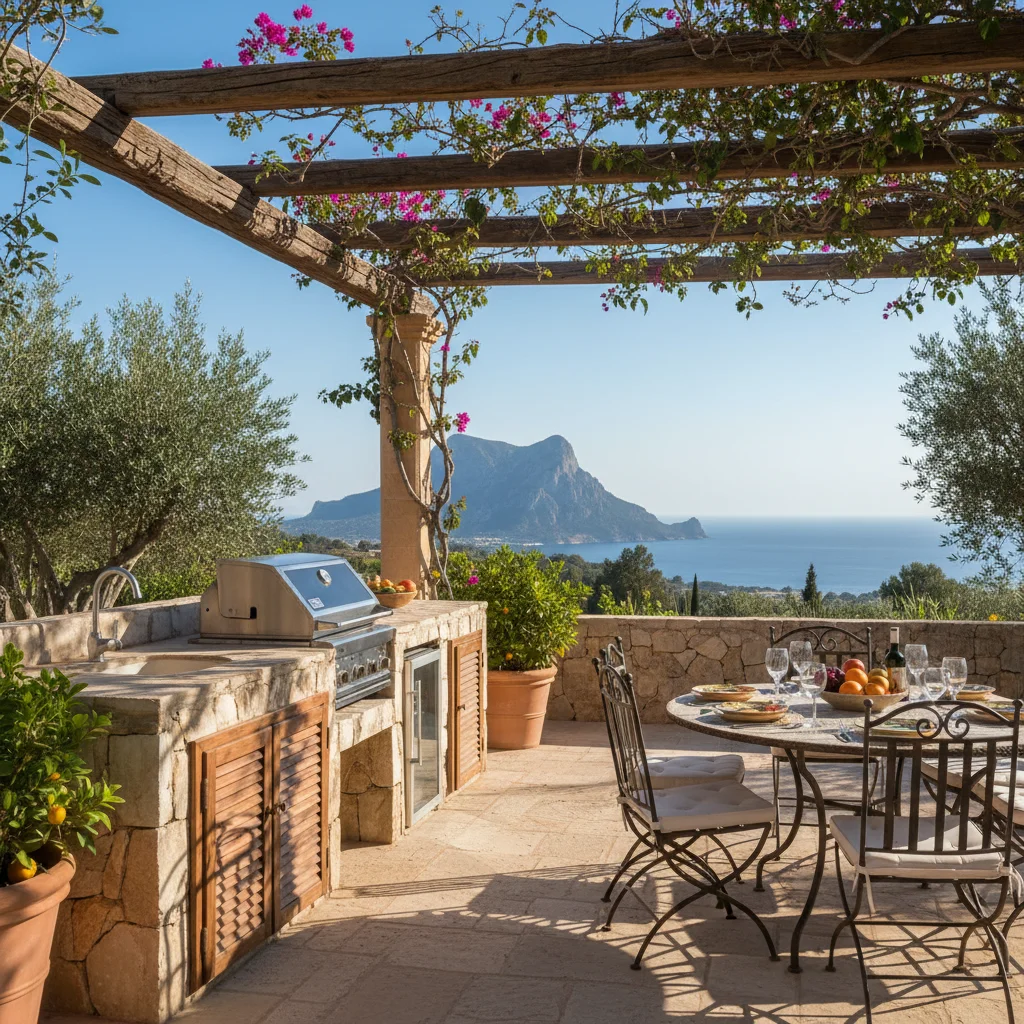
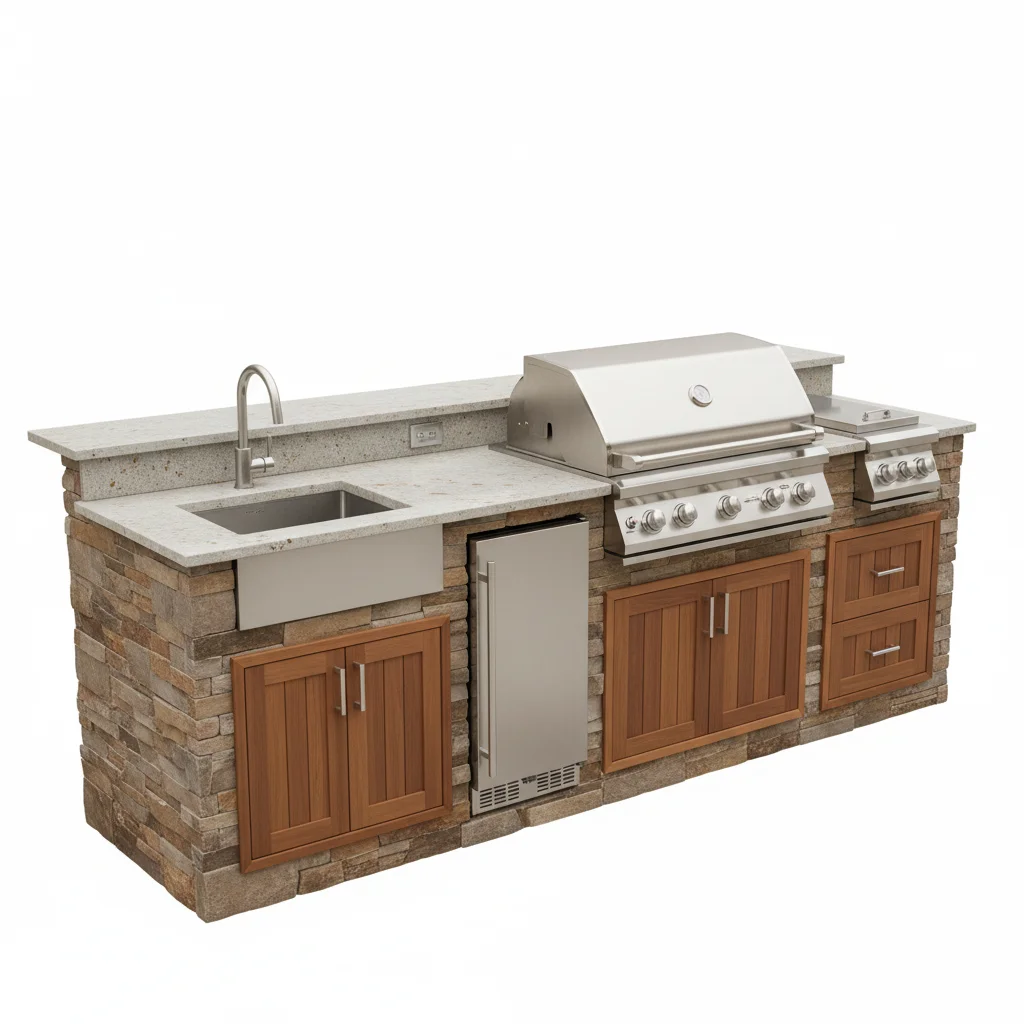
In areas like the Port or the bustling streets near the Arenal, the outdoor space is often about clever utilization of footprint. Even in luxury villas where space is more abundant, the design must respect the flow between the private pool area and the shaded "naya" or covered terrace. An outdoor kitchen here is an investment that typically ranges from 3,000 Euro for high-quality modular units to upwards of 25,000 Euro for bespoke, fully plumbed installations featuring premium stone worktops and integrated refrigeration. The goal is to create a space where the cook is never isolated from the guests, turning the act of preparing a meal into a shared experience that lasts from the late afternoon sun until the cooler evening breezes settle in from the bay.
Practical Engineering for the Montgó Microclimate
The geographic position of this town is unique due to the massive presence of the Montgó mountain, which acts as a literal shield against the harsher weather patterns that can plague other parts of the Costa Blanca. This microclimate provides a level of protection that is vital for the longevity of outdoor equipment. We experience a more moderate coastal breeze and generally lower humidity than the southern zones of the province, which is a significant advantage when maintaining an outdoor kitchen. However, do not let the sheltered environment lead to complacency regarding material choices. If your property is located near the Port or has a direct line of sight to the sea, the salt air remains a constant factor. Even with lower humidity, the salt-laden mist can be relentless. I always advise residents to insist on 316-grade stainless steel for any exposed metalwork or cabinetry. While 304-grade is acceptable further inland, the coastal proximity here will cause lesser metals to tea-stain and pit within a couple of seasons.
A factor often overlooked by newcomers is the impact of the "Calima"—the Saharan dust storms that occasionally sweep across the Mediterranean. These fine particles can settle into every crevice of a gas burner or a pizza oven. When we specify a kitchen for this area, we prioritize designs with minimal deep-set grooves and high-quality weather covers. A specific recommendation I often make for local villas is the inclusion of a modular gas system, such as those from Napoleon or Broil King, which can be integrated into a custom masonry or aluminum frame. A four-burner built-in unit with an infrared rear burner typically starts around 1,800 Euro for the component alone, and it provides the heat consistency needed to sear meat even when the evening breeze picks up.
You must also consider the regulations of your "comunidad de propietarios" if you live in an apartment complex or a shared urbanisation. Unlike standalone villas, these communities often have strict rules regarding smoke ventilation and the aesthetic appearance of terrace installations. It is essential to check your statutes before installing a wood-fired pizza oven, as the smoke can be a point of contention with neighbors. For villa owners, the considerations are more structural. The weight of a full kitchen, especially one using heavy granite or Dekton worktops which can weigh 50kg per square meter, requires a terrace floor that has been properly reinforced or verified by a technical architect. Furthermore, the local reliance on bottled gas—the ubiquitous orange "butano" cylinders—means your kitchen design must include ventilated, accessible storage that complies with Spanish safety standards (the "gas natural" grid is not universal here).
Configuration Strategies for Hillside and Coastal Properties
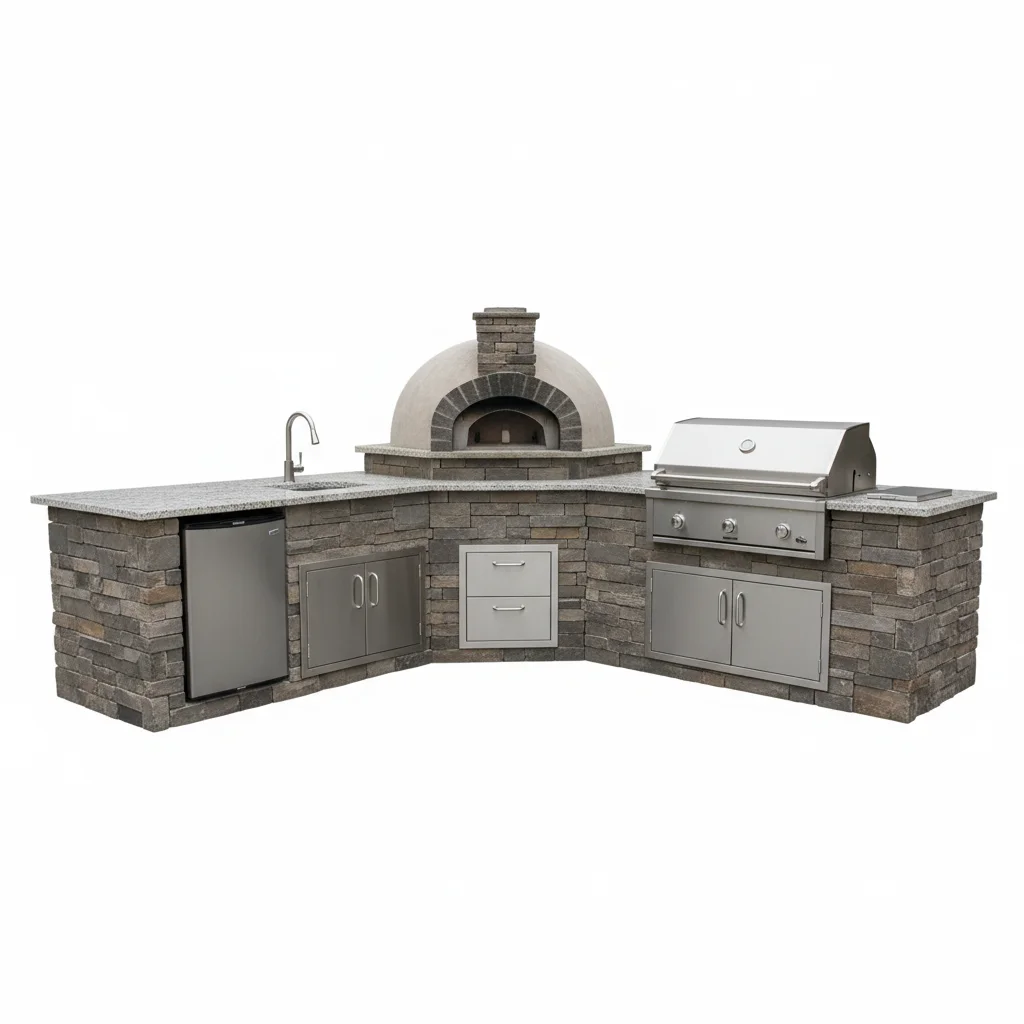
The choice of equipment should be dictated by the specific layout of your property. For the luxury villas perched on the slopes of the mountain or nestled in the pine-filled plots of the southern capes, I recommend a comprehensive L-shaped or U-shaped configuration. These larger spaces allow for a "zone" approach to cooking. On one side, a powerful gas BBQ serves as the primary workhorse for mid-week meals and large gatherings. This is perfectly complemented by a ceramic Kamado-BBQ, such as a Monolith or Big Green Egg, which excels in the dry heat of our summers by retaining moisture in the food during long roasts. Adding a dedicated pizza oven at the end of the counter creates a focal point for Sunday family lunches. A high-end setup of this nature, featuring durable worktops like Neolith that won't fade under the intense Spanish sun, typically represents an investment of 12,000 to 18,000 Euro, but it effectively doubles the usable square footage of your home’s kitchen.
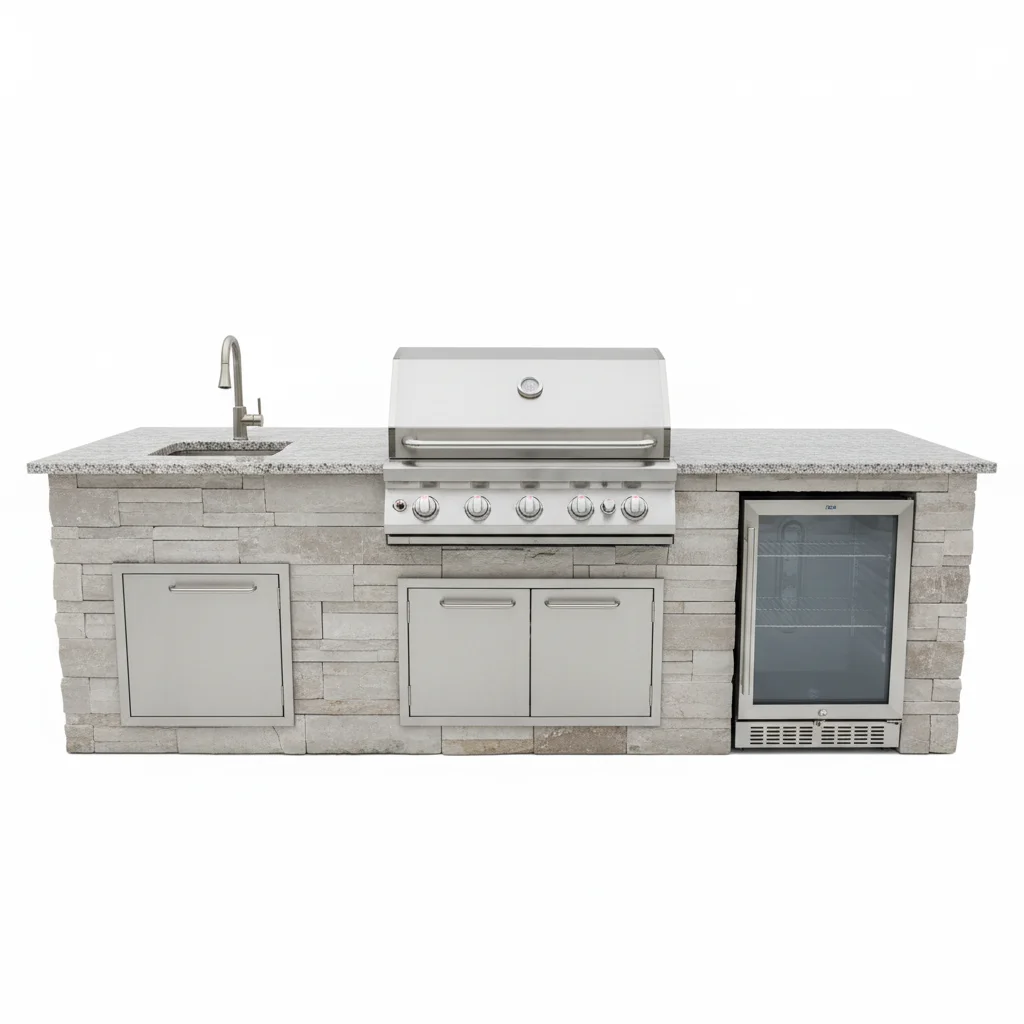
For the modern apartment terraces near the Arenal, space is at a premium, and the weight limit of the balcony is a primary constraint. In these scenarios, I suggest a linear modular setup. High-quality aluminum cabinetry is excellent here because it is lightweight, rust-proof, and can be powder-coated to match the joinery of the building. A compact, three-burner gas grill integrated with a small sink and a preparation area is usually sufficient. This setup allows you to keep the terrace uncluttered while still providing the capability to cook full meals outside. We often recommend incorporating a small outdoor fridge—specifically one rated for outdoor use that can handle the 35-degree Celsius peak summer temperatures—to keep drinks and ingredients cold without needing to retreat inside. A streamlined apartment kitchen of this quality can be achieved for approximately 4,500 to 7,000 Euro.
The integration of related products is where a kitchen truly becomes a professional-grade workspace. For those who enjoy the ritual of charcoal but want the speed of gas, a hybrid tray system is a smart addition. I also encourage the installation of a powerful side burner, often referred to as a "sizzle zone," which can reach temperatures of 800 degrees Celsius for searing steaks or can be used with a wok for stir-frying. This prevents the indoor kitchen from being filled with heat and odors during the height of July and August. Lighting is the final, crucial component; many of our local properties have beautiful ambient light, but you need dedicated task lighting directly over the cooking surface to ensure you aren't grilling in the dark after the sun sets behind the Montgó at 9:00 PM.
Logistics and Localized Installation Expertise
Delivering and installing heavy outdoor kitchen components in this part of the world requires more than just a van and a couple of lifters. My team and I are intimately familiar with the logistical hurdles of the local geography. We serve not just the main town but also the surrounding areas of Moraira, Dénia, Benitachell, Pedreguer, and the Jalón valley. Each of these locations presents its own challenges. For instance, delivering a 150kg pizza oven to a villa in the hills of Benitachell often involves navigating narrow, winding roads where a standard large delivery truck cannot pass. We maintain a fleet of smaller vehicles and have access to specialized crane services for those properties in the Port where the only way to get a kitchen onto a top-floor terrace is over the roof.
Our knowledge of local construction standards means we understand how to work with your existing plumbing and electrical feeds. Many older villas have external water points that aren't positioned correctly for a modern kitchen island, or they lack the dedicated electrical circuit needed for high-draw appliances like outdoor fridges and rotisserie motors. We don't just drop off boxes; we ensure the site is ready and the installation is seamless. We know that in the "Old Town," access is restricted by narrow streets and stone arches, requiring precise timing and coordination with local authorities for loading and unloading permits.
When you work with us, you are gaining an expert neighbor who understands the nuances of living here. We know which way the wind typically blows across your terrace and how that will affect the draw of your BBQ hood. We understand the importance of choosing materials that won't burn your hands when they’ve been sitting in the 2:00 PM sun. My goal is to ensure that your outdoor kitchen is as functional five years from now as it is on the day of installation. I invite you to reach out for a free consultation at your property. We can walk through your space together, discuss your cooking style, and I can provide a detailed, no-obligation quote that accounts for every technical and environmental factor specific to your location. Let's build a space that truly reflects the outdoor lifestyle we all moved here to enjoy.
 JW'"
/>
JW'"
/>